

How to choose an AI voice agent: a 12-point checklist
Choose an AI voice agent by testing it against production reality, not the demo: latency under load, voicemail and interruption handling, model choice, multilingual quality, in-call actions, integrations, compliance, observability, transparent pricing, concurrency, and clean human handoff. This 12-point checklist gives you the exact questions to ask each vendor.
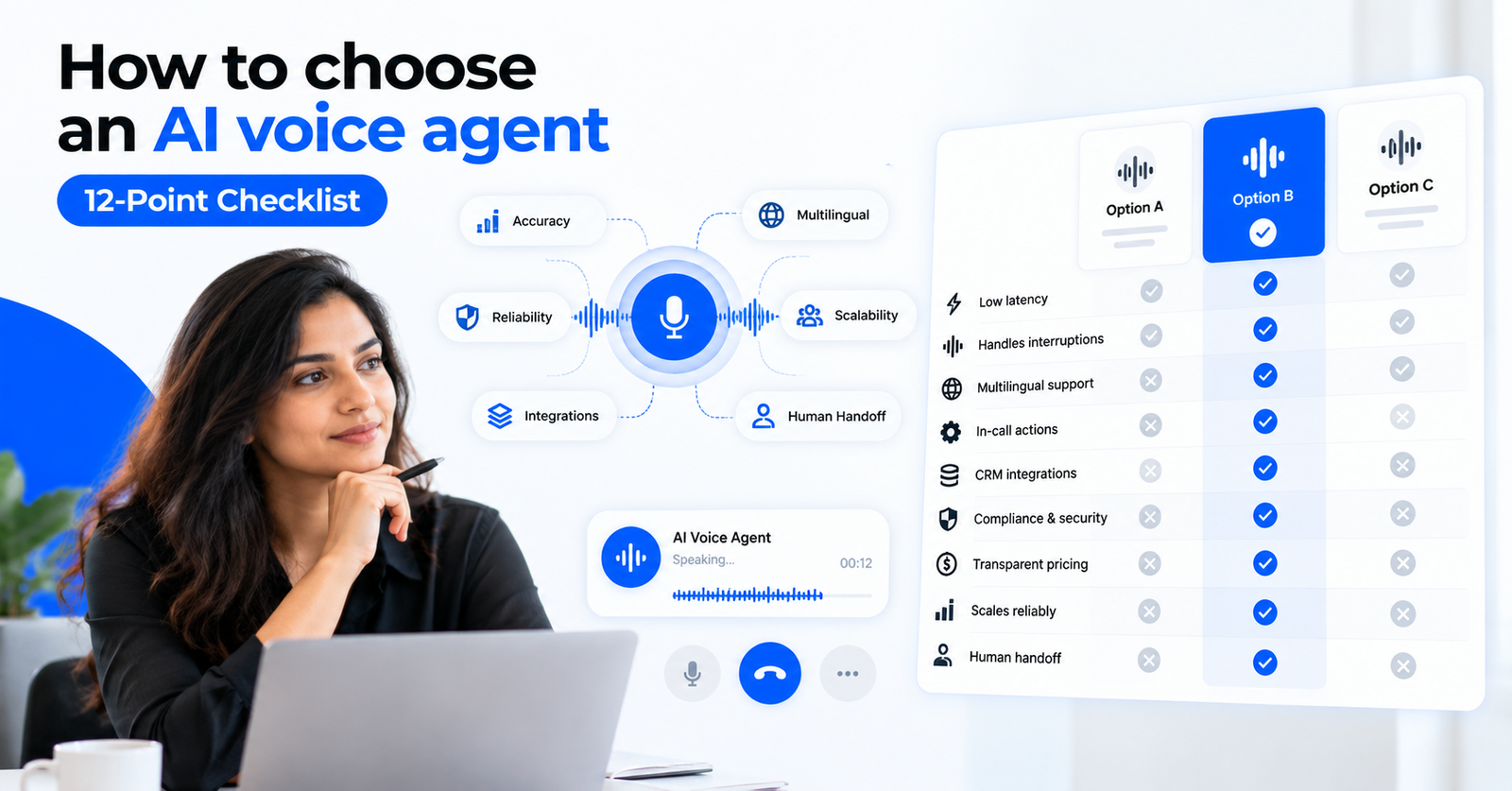
Choosing an AI voice agent comes down to one question: will it survive contact with real calls? Demos are tuned; production is noisy, multilingual, interrupted, and full of voicemail. The right way to evaluate is to score every vendor against the twelve things that actually break in production — and to insist on hearing how each one works, not just whether it's on the feature list.
Use this as a scorecard. Bring the same twelve questions to each vendor, run the same test calls, and the differences surface fast. For the wider landscape, start with our complete guide to AI voice agents; if you're weighing named platforms, see the best AI voice agent platforms in 2026.
1. Latency — measure it under load, on your telephony
Conversational latency is the single most felt quality. Above roughly 800ms–1s of round-trip delay, callers start talking over the agent and the illusion breaks. But the number that matters isn't the one on the marketing page — it's the p95 latency on your carrier, in your region, at your concurrency. A platform can look snappy on a single WebRTC demo and fall apart on a busy PSTN trunk halfway across the world.
- Ask for p50 and p95 turn latency, not an average.
- Test on the telephony you'll actually use (SIP/PSTN, not just the browser widget).
- Run it while other calls are live — latency that only holds at low volume is not latency you can ship.
2. Voicemail / answering-machine detection (AMD)
On any outbound program, a large share of calls hit voicemail. Weak detection means your agent either talks over greetings or burns paid minutes on machines. Good detection fuses carrier signals with live-audio classification, waits for the beep before speaking, and handles the race between the two signals cleanly.
Don't accept "yes, we do voicemail detection." Ask how. We wrote the honest version of this in how AI voice agents detect voicemail — use it as your question bank.
3. Barge-in and interruption handling
Real people interrupt. If the agent can't stop mid-sentence when the caller starts talking — and cleanly resume or re-plan — it feels robotic and frustrating. Test it deliberately: interrupt the agent early, interrupt it mid-word, say "no wait" halfway through a confirmation. Watch whether it stops instantly, whether it mishears its own audio as caller speech (echo), and whether it recovers context after the interruption.
4. Model choice: STT, LLM, TTS — and speech-to-speech
There is no single best stack. A pipeline of separate speech-to-text, an LLM, and text-to-speech gives you control and verbatim output; a newer speech-to-speech model gives you naturalness and lower latency but paraphrases what you wrote. Compliance-sensitive scripts often need the classic pipeline; natural conversation often favors speech-to-speech.
The platform should let you choose per use case rather than locking you to one model. Ask what happens when a model you depend on is deprecated — vendors sunset models regularly, and being stranded is a real risk. See voice AI model migrations and sunsets and building on a frozen speech-to-speech model for what mature handling looks like. Compare the tradeoffs at Callaro's models and languages.
5. Multilingual quality — accents and code-switching
If your callers speak more than one language, generic multilingual support is not enough. The hard cases are accented speech, mid-sentence code-switching (a caller who mixes two languages in one breath), and speech-to-text that returns the wrong script. Test with real callers from your market, not clean studio audio.
Ask how the platform handles a caller who switches languages mid-call, and how it deals with wrong-script transcription. Our field notes on multilingual voice AI, accents, and code-switching cover what actually goes wrong.
6. In-call actions and orchestration (tools, APIs, MCP)
An agent that only talks is a fancy IVR. The value is in doing things mid-call — looking up an account, booking a slot, taking a payment reference, updating a CRM record — by calling your APIs and tools while the conversation continues. Ask how the platform triggers tools, how it handles a slow or failing API without dead air, and whether it supports standard interfaces (function calling, webhooks, MCP).
See how we approach this in Callaro's orchestration.
7. Integrations and CRM
The agent has to live inside your stack: your CRM, your telephony, your ticketing, your data warehouse. Check for native integrations vs. "you can build it with webhooks," and confirm the direction of data flow — can it both read context before a call and write outcomes after? A voice agent that can't log its own results creates more work than it saves.
8. Compliance and calling windows
Regulation is not optional. Depending on your market and use case you may need consent capture, call recording controls, do-not-call suppression, time-of-day calling windows, opt-out handling, and data residency. This matters most in regulated functions like collections — see AI voice agents for collections and the loan and EMI collections solution. Ask specifically how the platform enforces calling windows per region and how it proves consent after the fact.
9. Observability and after-call analysis
You cannot improve what you cannot see. A production platform gives you transcripts, recordings, per-call latency and event timelines, sentiment, outcome tagging, and a way to trace why a call went the way it did. When something goes wrong on call 40,000, you need the timeline — which signal fired when, where the agent hesitated — not a shrug. Weak observability is a hidden cost that shows up as weeks of blind tuning.
10. Pricing transparency
Per-minute rates are only the visible layer. Ask what's bundled and what's metered separately: telephony, STT, LLM tokens, TTS, concurrency, phone numbers, add-ons. Some platforms quote a low headline rate and pass model costs straight through. Model the total cost for a realistic month, not a single call. Our breakdowns on how much AI voice agents cost and AI calling cost transparency show where the hidden line items hide; check the published pricing against them.
11. Scale and concurrency
A pilot runs ten calls; a campaign runs thousands at once. Ask about concurrency limits, how pacing works on outbound (so you don't overwhelm your own team on transfers), what happens when you hit the ceiling, and whether concurrency is a hard cap or an elastic tier. Test a burst, not a trickle — the failure modes at scale (queueing, dropped calls, rate limits) never appear in a one-call demo.
12. Human handoff
The agent should know its limits and hand off gracefully. Check that it can detect when to escalate (explicit request, repeated confusion, high-stakes intent), transfer with context so the human isn't starting cold, and do a warm handoff rather than dumping the caller into a queue. A clean handoff is often what separates a voice agent customers tolerate from one they trust.
13. Omnichannel reach — one agent, one memory
Ask whether the same agent can follow the customer off the phone. Can it send a WhatsApp, SMS or email mid-call? Can a website or in-app chat become a call that keeps the context? Does a reply on another channel tomorrow land on the same customer memory? Platforms that need a separate bot per channel duplicate your build work and break the journey. Callaro runs one agent across voice, WhatsApp, web and app chat, SMS, RCS, email and an API channel, with cross-channel actions and one team inbox.
How to run the evaluation
Don't score on paper. Pick three or four representative call scenarios from your own operation, script the same test for every vendor, and run them on your telephony and in your languages. Then:
- Weight the criteria to your use case. Outbound collections weights AMD, compliance, and concurrency heavily; inbound support weights latency, barge-in, and handoff.
- Probe the "how," not the "whether." Every vendor will say yes to the checklist. The follow-up questions in each section above are where real differences appear.
- Insist on observability during the trial. If you can't see transcripts and timelines in the pilot, you're buying blind.
If your decision is really "do I even need voice AI versus a menu tree or a chatbot," back up one step and read AI voice agent vs IVR vs chatbot first. And when you're comparing named vendors head-to-head, our comparison pages line up the specifics.
Written by Callaro Team
Field notes from the team building Callaro's voice AI platform.
Frequently asked questions
What is the most important factor when choosing an AI voice agent?+
It depends on your use case, but conversational latency and reliability under real load are near-universal. If the agent lags or breaks at production concurrency, nothing else matters. Weight the rest of the checklist — voicemail detection, compliance, multilingual quality — according to whether you run inbound support, outbound campaigns, or collections.
Should I pick a platform with one AI model or model choice?+
Prefer model choice. A classic speech-to-text, LLM, and text-to-speech pipeline gives verbatim control for compliance-sensitive scripts, while a speech-to-speech model gives more natural, lower-latency conversation but paraphrases. A platform that lets you choose per use case — and handles model deprecations gracefully — avoids locking you into a single tradeoff.
How do I test AI voice agent latency properly?+
Measure p50 and p95 turn latency on your own telephony (SIP/PSTN, not just a browser demo), in your region, while other calls are live. Averages and single-call demos hide the tail latency that actually causes callers to talk over the agent.
What questions reveal whether voicemail detection is any good?+
Ask whether the platform fuses carrier signals with live-audio classification, whether it waits for the beep before leaving a message, how it handles the race between two detection signals, and whether it tunes grace windows by region. Vague answers usually mean naive detection that talks over greetings or wastes minutes on machines.
Why does in-call orchestration matter more than the conversation itself?+
An agent that only talks is essentially a better IVR. The business value comes from taking actions mid-call — looking up accounts, booking slots, updating your CRM, calling your APIs — without dead air when a system is slow. Ask how the platform triggers tools and how it handles slow or failing API calls.
How should I compare AI voice agent pricing across vendors?+
Look past the per-minute headline rate. Ask what is bundled versus metered separately — telephony, speech-to-text, LLM tokens, text-to-speech, concurrency, phone numbers — and model the total cost for a realistic month of your volume. Some platforms pass model costs straight through on top of a low advertised rate.
Related articles

Gemini Live retirement: what changes for voice agents on 17 November
Google retires the Gemini API's preview Live and TTS models on 17 November 2026. Swapping in Gemini 3.8 Live is a one-line change; its new defaults for tool calls, silence and TTS prompts are not. Here is what changes, which date applies on which surface, and how to re-test each agent.

Voice AI for BPOs and contact centers: sell outcomes, not seats
For a BPO, voice AI is a commercial decision before it's a technology one. Put the AI tier where clients get nothing today (overflow, after-hours, callbacks, quality review), price it on resolved outcomes, and work out your containment floor before you quote: a transferred call costs more than a human-only one, so break-even sits higher than most teams assume.

Omnichannel AI agents explained: test the seams, not the channel list
An omnichannel AI agent is one agent with one memory per customer, serving calls, WhatsApp, chat, SMS, RCS and email, and able to act across them mid-conversation. Every vendor now claims that, so the label tells you little. What separates platforms is the six seams where a journey crosses channels: identity, memory, action, events, people and consent. Here's what breaks at each, and how to test it.
See the platform run a real call.
Book a demo and we'll show you outcomes executed end-to-end.
Book a demo