
Building on a frozen speech-to-speech model: the delegation pattern behind natural voice AI
Speech-to-speech models sound remarkably human, but they hand you a locked instruction budget, no mid-call edits, and behavior you can't fully control. The way production teams get real work out of them is a delegation pattern — the live model talks, a second model does the thinking. Here's how it works and where it breaks.
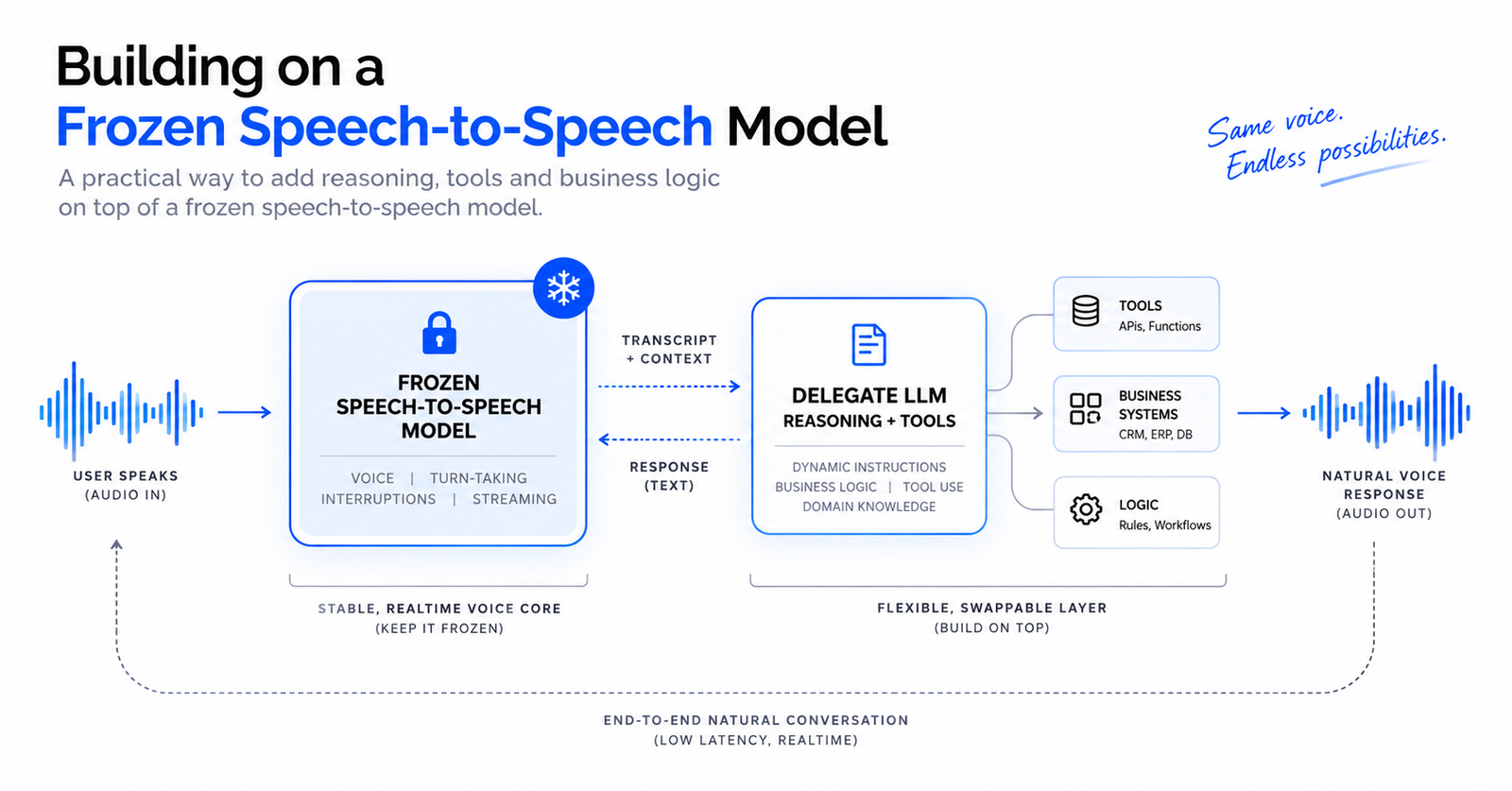
Speech-to-speech models — audio in, audio out, no separate transcription or text-to-speech step — are the most natural-sounding voice AI available. They're also the most constrained thing to build a real product on: the instructions are locked at the start of the session, you can't edit them mid-call, and the model voices whatever it decides to say with limited room for your business logic. The pattern that makes them usable in production is delegation: the live speech model handles the conversation and the voice, while a second, swappable "delegate" model does the actual thinking and tool calls. This post explains that architecture and, just as importantly, where it gets hard.
This is where a lot of voice AI is heading, so it's worth understanding. For the ground-level basics first, see the complete guide to AI voice agents.
What a speech-to-speech model gives you — and takes away
The upside is obvious the first time you hear one: natural prosody, real interruptions, no robotic TTS seams. The constraints are less obvious and they shape the entire architecture:
- A fixed, one-shot instruction budget. You get a bounded number of instruction tokens, set once at session start, with no replace. Everything the model needs to be has to fit, up front.
- No mid-call instruction edits. You can't rewrite the system prompt when the conversation changes topic.
- It voices, it doesn't render. A speech-to-speech model says text in its own voice; it can paraphrase. It is not a TTS engine playing your exact string.
- A speech-model knowledge cutoff that's often earlier than the text models you're used to.
- Concurrency ceilings — realtime sessions are capped per tier, which is a real constraint for bulk outbound.
If you tried to cram all your tools, policies, and dynamic knowledge into that frozen instruction budget, you'd run out immediately and still couldn't change anything mid-call. Hence delegation.
The delegation pattern
Split the job in two:
- The live speech model owns the audio: listening, turn-taking, interruptions, and speaking. It's the mouth and ears.
- A delegate model (any capable text LLM) owns the reasoning: deciding what to do, calling tools, extracting data, applying business logic. It's the brain.
The live model, when it needs something done, hands off to the delegate; the delegate's answer comes back and the live model voices it. Crucially, the delegate is the mutable half — you can change delegate models, prompts, and tools freely, because the frozen part (the speech model) only needs to know how to converse and when to delegate.
This also solves the instruction-budget problem elegantly: tool definitions live with the delegate, costing zero of the live model's tight instruction budget. You can wire in dozens of tools without touching the speech model's limits, and swap the delegate for any backend model you like.
Where it gets hard (the parts demos skip)
1. Don't freeze the audio loop while the brain thinks
The naive implementation awaits the delegate call inline — and freezes the receive loop for the whole LLM-plus-tool round trip. No audio, no transcripts, no barge-in until it returns. The user experiences a dead call. The fix is to run delegation as a background task so audio keeps flowing while the delegate works, then inject the result when it's ready.
2. Every delegated token is spoken — and billed as voice
Because the live model voices the delegate's output, a long delegate answer becomes minutes of speech. An 8,000-token essay from the delegate is roughly ten minutes of talking — expensive and unusable. Delegation has to be tuned to return tight answers, and you have to think about cost in spoken wall-clock time, not just tokens.
3. Send the delta, not the whole transcript
If each delegation resends the entire conversation so far, the k-th delegation carries k overlapping copies of the dialogue — cost and latency balloon. Send only what's new since the last handoff.
4. Transfers and verbatim messages need care
When the agent transfers a call, the speech model holds no tools and the delegate's text arrives after the provider transfer already fired — so the caller can hear a silence gap unless you design for it. And because the model paraphrases, any message that must be exact (a compliance disclosure, a legal script) should be rendered through a classic TTS pipeline instead. Mature platforms let you pick per use case. (Related: how we sequence tools and handoffs in orchestration, and the verbatim tradeoff in voicemail detection.)
5. Sessions expire; long calls need reconnect logic
Realtime sessions have a lifetime. Without explicit reconnect handling, a long call simply ends when the session expires. This is easy to miss in testing (short calls) and painful in production (that one 20-minute call that dies at minute 15).
Why the pattern matters to buyers
Delegation is why a platform can offer the natural sound of a speech-to-speech model and deep tool use, your choice of reasoning model, and controllable behavior. A platform that only exposes the raw speech model gives you great audio and shallow capability; one that only uses a pipeline gives you control but a more synthetic voice. The delegation architecture is how you stop choosing.
When evaluating, ask: Can I use a speech-to-speech voice and call my tools and CRM mid-call? Can I choose the reasoning model independently of the voice? What happens on long calls, transfers, and messages that must be exact? The quality of those answers tells you whether a team has actually shipped this or just demoed it.
More on how we approach model and channel choice in models & languages, and how to weigh all of this when choosing a voice AI agent.
Written by Callaro Engineering
Field notes from the team building Callaro's voice AI platform.
Frequently asked questions
What is a speech-to-speech voice AI model?+
A speech-to-speech model takes audio in and produces audio out directly, without separate speech-to-text and text-to-speech steps. This makes it sound more natural with better turn-taking, but it's more constrained: instructions are fixed at session start and it voices text in its own way rather than reading it verbatim.
What is the delegation pattern in voice AI?+
Delegation splits the agent into a live speech model that handles audio (listening, speaking, interruptions) and a separate delegate LLM that handles reasoning and tool calls. The live model voices the delegate's answers. This keeps natural audio while allowing deep tool use and a swappable reasoning model.
Why can delegated responses get expensive?+
Because the live speech model voices the delegate's output, a long delegate answer becomes minutes of spoken audio — billed as voice time. An 8,000-token answer is roughly ten minutes of speech, so delegation must be tuned to return tight responses.
Can a speech-to-speech agent still guarantee exact wording?+
Not reliably — it paraphrases. For messages that must be legally or commercially exact, render them through a classic text-to-speech pipeline where the output matches the text exactly. A good platform lets you choose per use case.
Related articles

Gemini Live retirement: what changes for voice agents on 17 November
Google retires the Gemini API's preview Live and TTS models on 17 November 2026. Swapping in Gemini 3.8 Live is a one-line change; its new defaults for tool calls, silence and TTS prompts are not. Here is what changes, which date applies on which surface, and how to re-test each agent.

Voice AI for BPOs and contact centers: sell outcomes, not seats
For a BPO, voice AI is a commercial decision before it's a technology one. Put the AI tier where clients get nothing today (overflow, after-hours, callbacks, quality review), price it on resolved outcomes, and work out your containment floor before you quote: a transferred call costs more than a human-only one, so break-even sits higher than most teams assume.

Speech-to-speech vs pipeline voice AI: choose per call, not per platform
Speech-to-speech and pipeline voice agents are no longer separated by latency. After eight days in which every pipeline stage gained a faster model and speech-to-speech systems stopped blocking on reasoning, the choice comes down to which guarantees a call needs. Here is what each path can't do, from running both in production, and a rule for choosing per call type.
See the platform run a real call.
Book a demo and we'll show you outcomes executed end-to-end.
Book a demo