

AI voice agents for collections: compliant recovery at scale
AI voice agents recover more debt at lower cost by calling every early-bucket account the day it slips, holding a calm and compliant conversation, capturing a promise-to-pay, and sending a payment link on the call. Compliance and empathy are the whole game — get them right and your human collectors are freed to work the hard accounts. Here's the playbook.
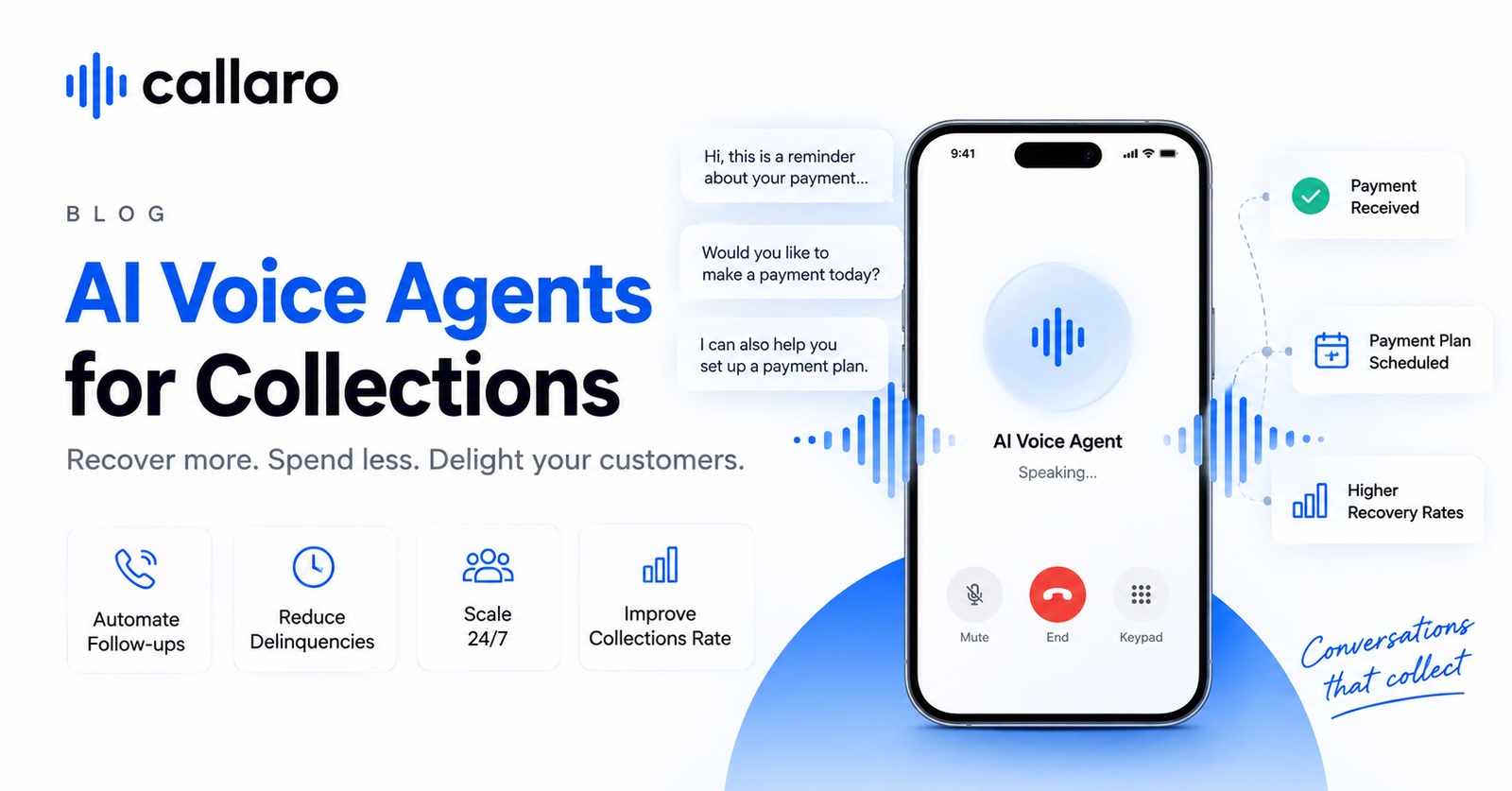
AI voice agents recover more debt at lower cost by doing what a human collections floor can't do consistently: calling every early-bucket account the day it goes past due, holding a calm, respectful, fully compliant conversation, capturing a promise-to-pay, and delivering a payment link before the call ends. Compliance and tone are not add-ons here — they are the product. Get them right and you recover more while freeing your human collectors to focus on the hard accounts that genuinely need judgment.
This is a practical playbook for deploying AI in collections. For the fundamentals of the technology, start with our complete guide to AI voice agents, and for the deeper operational detail see our EMI collections voice AI playbook.
Start where it's easy: early-bucket reminders
The highest-ROI use of AI in collections is the earliest bucket — accounts that are a few days to a few weeks past due. These borrowers mostly intend to pay; they forgot, they're between paydays, or a payment failed. They don't need pressure. They need a timely, friendly reminder and an easy way to pay.
This is precisely the volume that overwhelms human floors. There are far more early-bucket accounts than collectors, so the reminders either go out late, inconsistently, or not at all. An AI agent calls every one of them on schedule, the day the account slips, with the same calm script every time. Because these conversations are structured and low-conflict, they're ideal for automation, and moving them off the human queue is where the economics flip. We break the bucket strategy down further in the EMI collections playbook.
Compliance is the foundation, not a feature
Collections is one of the most regulated activities there is, and the rules vary by region, so treat compliance as the non-negotiable frame around every call. Region-neutral principles that hold broadly:
- Calling hours. Only call within locally permitted windows, computed against the borrower's time zone. Never call outside them, ever.
- Do-not-call and cease-contact. When a borrower asks you to stop calling, or to contact them only in writing, that must be honored immediately and propagate across every campaign in real time.
- Mandatory disclosures. Many jurisdictions require the agent to identify who is calling, state that the call concerns a debt, and give required notices. Script these as fixed, verbatim elements the agent always delivers.
- Frequency caps. Don't call the same account repeatedly in a day. Set and enforce per-account attempt limits with sensible back-off.
- Accurate records. Log every call, outcome, and disclosure so the program is auditable.
A subtle but important point: where a message must be legally exact — a required disclosure — you want the agent to deliver it verbatim, not paraphrased. That's an architectural choice about how the voice is rendered, and a mature platform lets you guarantee exact wording where the law demands it. We cover that tradeoff in how AI voice agents detect voicemail, where the same verbatim requirement applies to voicemail disclosures.
Tone and empathy: the difference between recovery and complaints
The fastest way to ruin a collections program — AI or human — is a hostile or robotic tone. People in financial stress remember how they were treated. An aggressive agent generates complaints, disputes, and churn; a respectful one recovers the money and preserves the relationship.
Design the agent to be calm, plain-spoken, and non-judgmental. It should acknowledge the person's situation, avoid pressure tactics, and offer help rather than threats. When a borrower explains a genuine hardship, the agent should respond with an appropriate path — a revised date, a plan, or an escalation to a human — not a scripted demand. This is also where honesty about being an automated call matters: a brief, matter-of-fact acknowledgment maintains trust. Empathy isn't softness; it's what makes people pick up the next time you call.
There's a consistency dividend here that human floors struggle to match. A tired collector at the end of a hard shift may let frustration into their voice; an AI agent delivers the same measured, courteous tone on the thousandth call as on the first. Combined with the multilingual reach to speak to each borrower in their own language, that consistency lowers complaint volume and keeps the relationship intact even when the money conversation is difficult — see multilingual voice AI, accents and code-switching for why speaking the borrower's language matters in sensitive calls.
Capture the promise-to-pay
The core outcome of an early-bucket call is a promise-to-pay (PTP): a specific commitment to pay a specific amount by a specific date. A good agent guides the conversation toward that commitment, confirms it clearly, and records it structurally so your system knows exactly what was promised and when to follow up.
Structured PTP capture is what makes the whole program measurable and actionable. It lets you schedule an automatic reminder before the promised date, flag broken promises for follow-up, and route reliable payers away from further contact. A vague "I'll try to pay soon" is worthless; a recorded "₹4,500 by the 28th" drives the next action.
Send the payment link on the call
Friction kills recovery. The moment a borrower agrees to pay, the easiest possible payment path should appear — typically a payment link sent by SMS or WhatsApp while they're still on the call, so they can pay immediately rather than "later" (which often means never).
This is where integration earns its keep: the agent should be able to generate and dispatch a payment link mid-conversation, tied to the specific account and amount, and ideally confirm receipt. Capturing intent and then making the borrower hunt for how to pay wastes the moment you just created. Delivering the link on the call converts promises into payments. This kind of mid-call action is exactly what orchestration enables — see how we orchestrate calls and tools.
Escalation: hand the hard accounts to humans
AI should own the high-volume, low-conflict early buckets and route everything harder to people. Escalate when:
- The borrower disputes the debt — disputes have legal handling requirements and need human judgment.
- Hardship or sensitive circumstances surface that call for a tailored arrangement or empathy beyond the agent's scope.
- The account is deep in delinquency — later buckets need negotiation, settlement authority, and experience.
- The borrower requests a human, which should always be honored promptly.
Drawing this line clearly is what makes the program both effective and humane: routine reminders are automated at scale, and the cases that need a person get one.
Let your collectors focus on what matters
The strategic payoff isn't just cheaper calls — it's reallocation. When AI handles the enormous volume of early-bucket reminders, your skilled human collectors stop spending their days on "you forgot to pay" calls and start spending them on the complex, high-value accounts where negotiation and judgment actually move recovery. You recover more from the easy accounts (because they all get called, on time, every time) and more from the hard ones (because your best people are focused there). That's the real case for AI in collections.
Measuring the program
Track contact rate (accounts reached), PTP rate (promises captured per contact), PTP-kept rate (promises that converted to payment), recovery rate and amount, and cost per recovery. Watch complaint and dispute rates as guardrails — if they rise, revisit tone and compliance before anything else. For how these outcomes map to spend, see how much AI voice agents cost.
If you're evaluating this for a lending or BFSI book, our loan and EMI collections solution walks through deployment, and choosing an AI voice agent covers the vendor questions that matter most in a regulated context.
Written by Callaro Team
Field notes from the team building Callaro's voice AI platform.
Frequently asked questions
Where do AI voice agents add the most value in collections?+
In the earliest buckets — accounts a few days to a few weeks past due. These borrowers mostly intend to pay and just need a timely, friendly reminder and an easy way to do it. This volume overwhelms human floors, so an AI agent that calls every account on schedule with a consistent, compliant script is where the economics flip and recovery improves.
How do AI collections calls stay compliant?+
Compliance is the frame around every call: dial only within locally permitted hours computed against the borrower's time zone, honor do-not-call and cease-contact requests in real time, deliver mandatory disclosures verbatim, enforce per-account frequency caps, and log every call and outcome for audit. Rules vary by region, so these must be configurable per market rather than a single global setting.
Can an AI agent be empathetic in a collections call?+
Yes, and it must be. Design the agent to be calm, plain-spoken, and non-judgmental — acknowledging the person's situation, avoiding pressure tactics, and offering help rather than threats. Hostile or robotic tone generates complaints and disputes; a respectful tone recovers the money and preserves the relationship, which is what makes borrowers answer next time.
What is a promise-to-pay and why capture it structurally?+
A promise-to-pay (PTP) is a specific commitment to pay a specific amount by a specific date. Capturing it structurally — not as a vague 'I'll try soon' — lets the system schedule reminders before the due date, flag broken promises for follow-up, and route reliable payers away from further contact. It's what makes the program measurable and drives the next action.
How does sending a payment link on the call help recovery?+
Friction kills recovery. The moment a borrower agrees to pay, the agent should send a payment link by SMS or WhatsApp tied to that account and amount while they're still on the call, so they can pay immediately rather than 'later.' Capturing intent and then making them hunt for how to pay wastes the moment; delivering the link converts promises into payments.
Which accounts should escalate to human collectors?+
Escalate disputed debts (legal handling requirements), hardship or sensitive circumstances needing a tailored arrangement, deeply delinquent accounts that require negotiation and settlement authority, and any borrower who asks for a human. AI owns the high-volume early buckets; humans focus on the complex, high-value accounts where judgment moves recovery.
Related articles

Voice AI for BPOs and contact centers: sell outcomes, not seats
For a BPO, voice AI is a commercial decision before it's a technology one. Put the AI tier where clients get nothing today (overflow, after-hours, callbacks, quality review), price it on resolved outcomes, and work out your containment floor before you quote: a transferred call costs more than a human-only one, so break-even sits higher than most teams assume.

Omnichannel AI agents explained: test the seams, not the channel list
An omnichannel AI agent is one agent with one memory per customer, serving calls, WhatsApp, chat, SMS, RCS and email, and able to act across them mid-conversation. Every vendor now claims that, so the label tells you little. What separates platforms is the six seams where a journey crosses channels: identity, memory, action, events, people and consent. Here's what breaks at each, and how to test it.

Voice AI for home services: triage first, book second
In home services, a voice AI agent earns its place on the calls nobody can pick up, and its first job on those calls is triage, with booking second. Sort every call into one of four lanes (safety, emergency dispatch, routine booking, not a new job), give each its own ending, and design for the moment the on-call phone doesn't answer.
See the platform run a real call.
Book a demo and we'll show you outcomes executed end-to-end.
Book a demo