
Multilingual voice AI: handling accents and code-switching
The hard part of multilingual voice AI isn't translating between languages — it's handling one caller who speaks accented English, switches to Hindi mid-sentence, and expects the agent to keep up. Here's why accents and code-switching break naive systems, the difference between native language packs and accented English, and how to actually evaluate multilingual quality.
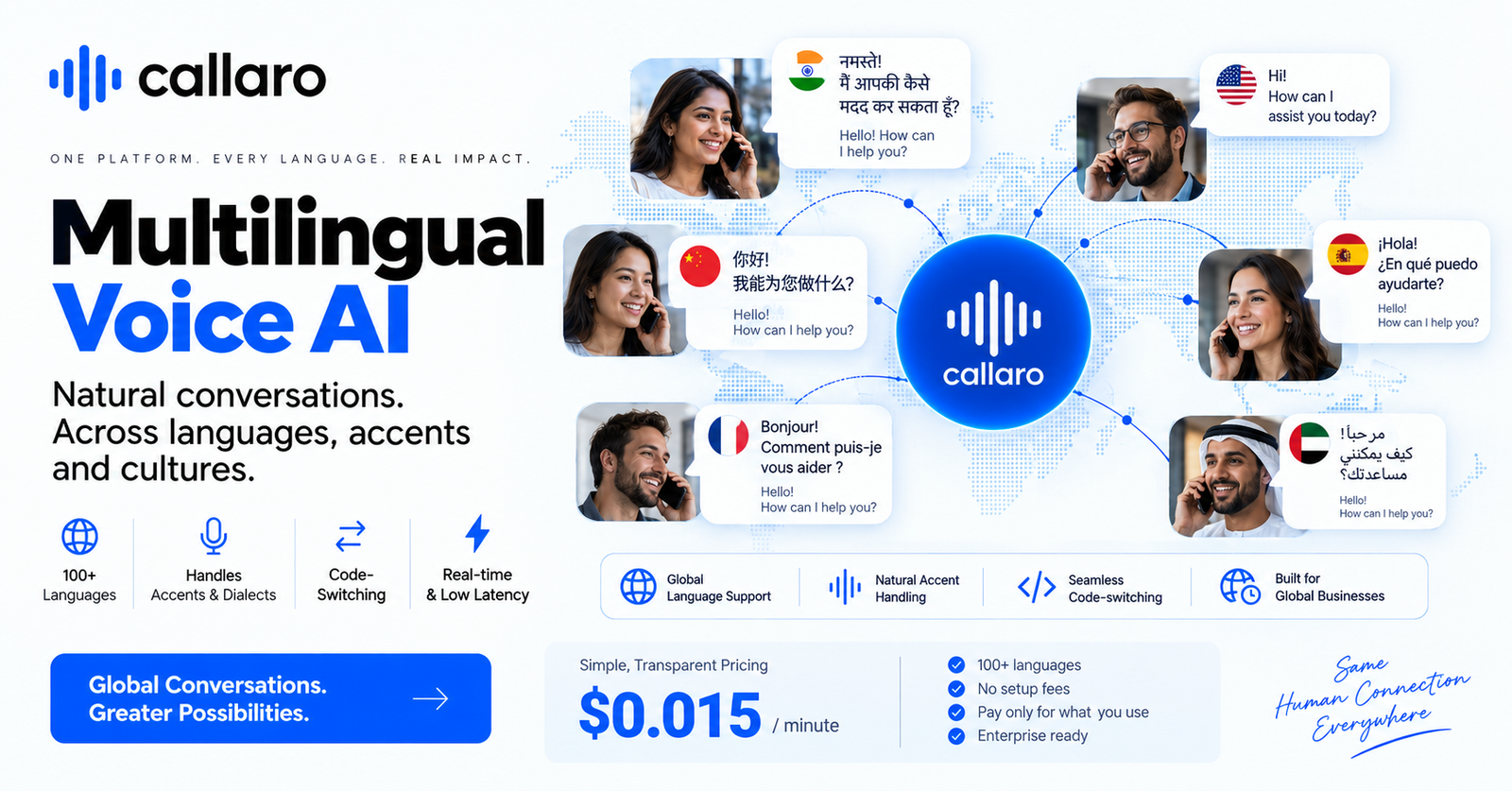
The hard problem in multilingual voice AI is not translating between languages — it is handling a single caller who opens in accented English, drops into Hindi halfway through a sentence, says a number in one language and a currency in another, and expects the agent to follow all of it in real time. Most platforms can demo "we support 30 languages." Far fewer survive a real call where the languages are mixed, the accent is regional, and the caller never signals a switch. This post is about that gap.
For the market-specific view, pair this with multilingual voice agents for India; for the bigger picture of how agents work, start from the complete guide to AI voice agents.
Why accents and code-switching are hard
Speech recognition is trained on distributions of audio. It is confident where it has heard a lot and shaky at the edges — and accents and code-switching live at the edges.
Accents move the acoustic signal away from whatever the transcription model saw most. A model trained heavily on US English will mishear an Indian, Nigerian, or Scottish speaker not because those accents are "wrong" but because they are under-represented in its training. The failure is quiet: the agent doesn't crash, it just mis-transcribes a word and answers the wrong question.
Code-switching — mixing languages inside one utterance — breaks a deeper assumption. Many pipelines pick one language per turn and transcribe the whole thing in it. But "मुझे EMI का due date change karna hai" is not a Hindi sentence or an English sentence; it is both, in the natural register millions of people actually speak. Force it into a single language and you get garbled output in either direction.
There is a subtler failure mode we have seen in production: the wrong-script transcription. The recognizer hears the words correctly but writes them in the wrong script — Hindi words rendered in Latin letters, or English words pushed into Devanagari. The meaning is technically there, but downstream text matching, tool calls, and the language model's own reasoning degrade because the text isn't in the form anything expects. Robust multilingual systems normalize script explicitly rather than trusting the recognizer's default.
Native language packs vs accented English
A common shortcut is to treat everything as English and lean on the model's tolerance for accents. It is cheaper and simpler, and for lightly-accented speakers it works. But there is a real quality ceiling: accented-English handling degrades exactly where the accent is strongest and where callers are most likely to code-switch into their first language.
The alternative is native language support — transcription and synthesis models built for the specific language, not English models stretched to cover it. For Indian languages, specialist engines tuned for Hindi, Hinglish, Indian English, and regional languages materially outperform a general English model on the same audio. The practical rule:
- Accented English is acceptable when your callers mostly speak one language with an accent, and switches are rare.
- Native language packs are necessary when callers genuinely speak in their own language, or mix freely, and you care about the tail of the accent distribution — which, in most real markets, is a large share of your callers.
The deeper point is that this should be a choice you can make per deployment, not a limitation baked into the platform. The models and languages available under the hood decide whether you even have the option.
Pronunciation and normalization: numbers, currency, dates
Multilingual quality is won and lost on the small, unglamorous stuff — and numbers are the worst offender.
A caller says a phone number, an amount, or a date, and the agent has to both understand it and say it back correctly. This is harder than it looks:
- Numbers spoken in mixed languages. "Twenty-five thousand" might arrive as a mix of English and a local language, or in a local numbering system (lakhs and crores rather than thousands and millions). Naive normalization mangles it.
- Currency. "₹1,499" should be voiced as "one thousand four hundred ninety-nine rupees," not "rupee one four nine nine," and the right phrasing differs by language.
- Digit strings vs quantities. A phone number is read digit by digit; an amount is read as a quantity. The system has to know which is which from context.
- Dates and times. Formats and spoken conventions vary by locale.
When a message must be legally or commercially exact — a payment amount, a disclosure, an offer — this is another reason to prefer a pipeline with classic text-to-speech, where what you wrote is what plays, over a speech-to-speech model that paraphrases. We cover that tradeoff in the complete guide.
Language detection: when and how to switch
If the agent supports multiple languages, something has to decide which one the caller is speaking — and when to switch. The naive version switches the moment it thinks it heard a different language, which produces flapping: the agent lurches between languages on every ambiguous word, which is far worse than politely staying in one.
The disciplined version treats a switch as a decision that needs evidence. A useful design principle: require a couple of consecutive turns in the new language before committing to the switch. One stray English word inside a Hindi sentence is code-switching, not a language change; a caller who has now said two full turns in English is genuinely switching. Building in that hysteresis is the difference between an agent that feels stable and one that feels like it's arguing with itself.
Which brings up an architectural constraint worth knowing before you buy.
When speech-to-speech models limit language coverage
Speech-to-speech (realtime) models are wonderfully natural, but they handle language internally — you feed them audio and they respond, and you don't get to route the transcription to a language-specialist engine or force a script. That has two consequences for multilingual work:
- You inherit the model's languages. If the frozen model doesn't cover a language or handles a regional accent poorly, you cannot swap in a better transcriber for that call the way you can in a pipeline. Your coverage is the model's coverage.
- Explicit language switching is limited. In a pipeline you can run automatic detection and switching with tuned rules; with a single speech-to-speech model, language handling is whatever the model does natively, and you lose the knobs.
None of this makes speech-to-speech the wrong choice — for a market where the model's languages match your callers, it is often the best experience. But for a genuinely multilingual, heavily code-switching audience, a pipeline that lets you pick the right transcription model per language usually wins. This is exactly why the ability to choose your architecture per use case matters. See building on a frozen speech-to-speech model for the broader constraints of that approach.
How to evaluate multilingual quality
Don't trust the language count on the pricing page. Test it, with audio that looks like your real calls:
- Bring accented speakers. Not clean studio English — the actual accents and regional languages your customers use.
- Force code-switching. Say a sentence that starts in one language and ends in another. Say a number in one language and a noun in another. Watch whether the transcript and the reply hold together.
- Probe the numbers. Read a phone number, an amount with currency, and a date. Check both understanding and how the agent says them back.
- Trigger a switch — and a non-switch. Confirm the agent switches when the caller genuinely changes language, and does not flap on a single foreign word.
- Check the wrong-script trap. Ask to see raw transcripts. Words in the wrong script are a sign the system isn't normalizing, and it will bite you downstream.
- Test the tail, not the mean. Average quality is easy; the callers you lose are in the tail — the strongest accents, the fastest code-switchers, the noisiest lines.
Multilingual voice AI that actually sounds local is not about supporting the most languages. It is about handling one real caller — accent, mixed languages, spoken numbers, and all — without making them slow down for the machine. For how we approach the models and languages behind this, see models and languages, and for the market where this matters most, multilingual voice agents for India.
Written by Callaro Team
Field notes from the team building Callaro's voice AI platform.
Frequently asked questions
Why is code-switching hard for voice AI?+
Many speech pipelines pick one language per turn and transcribe the whole utterance in it. But code-switched speech mixes languages inside a single sentence — for example Hindi and English together — which is neither a pure Hindi nor a pure English sentence. Forcing it into one language produces garbled output, so the system has to be built to expect mixed-language input rather than assume one language per turn.
What is the difference between native language support and accented English?+
Accented English treats everything as English and relies on the model's tolerance for accents. It's cheaper and works for lightly-accented speakers, but degrades where accents are strongest and where callers code-switch into their first language. Native language support uses transcription and synthesis models built for the specific language, which materially outperforms stretched English models for speakers who genuinely talk in their own language or mix freely.
Do speech-to-speech models limit language coverage?+
Yes. Speech-to-speech models handle language internally, so you inherit whatever languages and accents the frozen model supports and cannot route a call to a better language-specialist transcriber the way you can in an STT/LLM/TTS pipeline. Explicit language detection and switching rules are also limited. For a heavily multilingual, code-switching audience, a pipeline that lets you pick the transcription model per language usually gives better coverage.
How should a voice agent decide when to switch languages?+
It should treat a switch as a decision that needs evidence rather than reacting to a single word. A good design requires a couple of consecutive turns in the new language before committing, which prevents 'flapping' — lurching between languages on every ambiguous word. One stray English word inside a Hindi sentence is code-switching, not a language change; two full turns in English is a genuine switch.
How do you evaluate multilingual voice AI quality?+
Test with audio that matches your real calls, not clean studio English. Bring genuinely accented and regional-language speakers, force code-switching within sentences, probe spoken numbers, currency and dates in both directions, confirm the agent switches on a real language change but not on a single foreign word, and ask to see raw transcripts to catch wrong-script transcription. Evaluate the tail — the strongest accents and fastest switchers — not just the average.
What is wrong-script transcription?+
It's when the recognizer hears the words correctly but writes them in the wrong script — for example Hindi words rendered in Latin letters, or English words pushed into Devanagari. The meaning is technically present, but downstream text matching, tool calls, and the language model's reasoning degrade because the text isn't in the expected form. Robust multilingual systems normalize the script explicitly instead of trusting the recognizer's default output.
Related articles

Gemini Live retirement: what changes for voice agents on 17 November
Google retires the Gemini API's preview Live and TTS models on 17 November 2026. Swapping in Gemini 3.8 Live is a one-line change; its new defaults for tool calls, silence and TTS prompts are not. Here is what changes, which date applies on which surface, and how to re-test each agent.

Voice AI for BPOs and contact centers: sell outcomes, not seats
For a BPO, voice AI is a commercial decision before it's a technology one. Put the AI tier where clients get nothing today (overflow, after-hours, callbacks, quality review), price it on resolved outcomes, and work out your containment floor before you quote: a transferred call costs more than a human-only one, so break-even sits higher than most teams assume.

Speech-to-speech vs pipeline voice AI: choose per call, not per platform
Speech-to-speech and pipeline voice agents are no longer separated by latency. After eight days in which every pipeline stage gained a faster model and speech-to-speech systems stopped blocking on reasoning, the choice comes down to which guarantees a call needs. Here is what each path can't do, from running both in production, and a rule for choosing per call type.
See the platform run a real call.
Book a demo and we'll show you outcomes executed end-to-end.
Book a demo