

Field notes on voice automation
Playbooks and teardowns from the team shipping omnichannel AI agents.
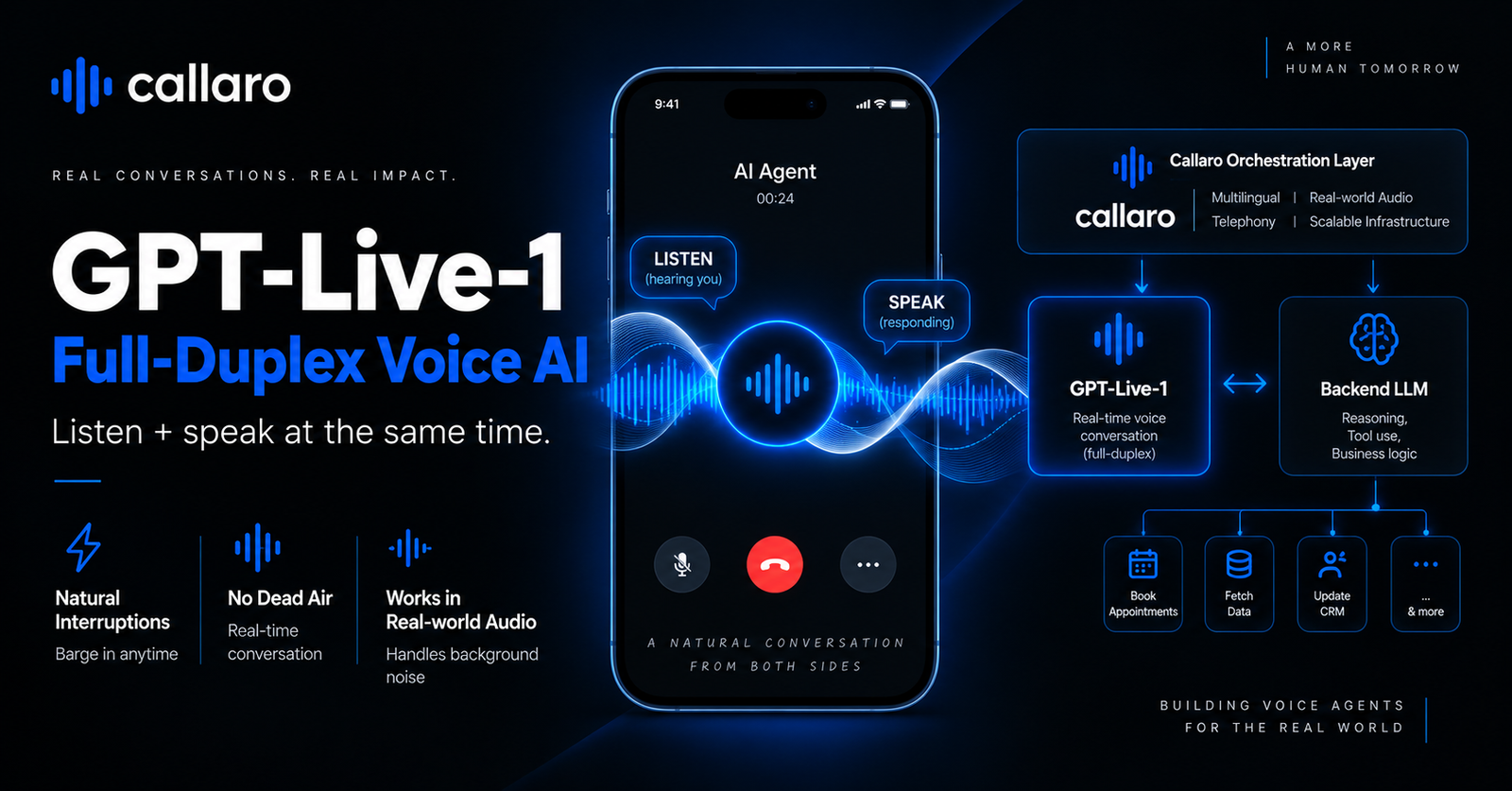
GPT-Live-1: full-duplex voice AI, and why Callaro was live with it on day one
OpenAI launched GPT-Live-1 on September 10, 2026 — a full-duplex speech model that listens and speaks at the same time and delegates reasoning to a backend of your choosing. Callaro has run it in production since launch day. Here's what full-duplex changes, and why it makes for the most natural AI voice agent yet.

Gemini Live retirement: what changes for voice agents on 17 November
Google retires the Gemini API's preview Live and TTS models on 17 November 2026. Swapping in Gemini 3.8 Live is a one-line change; its new defaults for tool calls, silence and TTS prompts are not. Here is what changes, which date applies on which surface, and how to re-test each agent.

Voice AI for BPOs and contact centers: sell outcomes, not seats
For a BPO, voice AI is a commercial decision before it's a technology one. Put the AI tier where clients get nothing today (overflow, after-hours, callbacks, quality review), price it on resolved outcomes, and work out your containment floor before you quote: a transferred call costs more than a human-only one, so break-even sits higher than most teams assume.

Omnichannel AI agents explained: test the seams, not the channel list
An omnichannel AI agent is one agent with one memory per customer, serving calls, WhatsApp, chat, SMS, RCS and email, and able to act across them mid-conversation. Every vendor now claims that, so the label tells you little. What separates platforms is the six seams where a journey crosses channels: identity, memory, action, events, people and consent. Here's what breaks at each, and how to test it.

Speech-to-speech vs pipeline voice AI: choose per call, not per platform
Speech-to-speech and pipeline voice agents are no longer separated by latency. After eight days in which every pipeline stage gained a faster model and speech-to-speech systems stopped blocking on reasoning, the choice comes down to which guarantees a call needs. Here is what each path can't do, from running both in production, and a rule for choosing per call type.

Voice AI for home services: triage first, book second
In home services, a voice AI agent earns its place on the calls nobody can pick up, and its first job on those calls is triage, with booking second. Sort every call into one of four lanes (safety, emergency dispatch, routine booking, not a new job), give each its own ending, and design for the moment the on-call phone doesn't answer.

Voice AI for travel: build the agent for disruption day
Voice AI earns its place in travel on the day a trip goes wrong, when call volume jumps and the phone queue fails. Build the agent for that day: call the travellers your notices missed, recognise the booking without asking anyone to spell a reference, offer only what your reservation system returns, and keep entitlement rules out of the model.

TRAI's A2P call rules for AI voice agents: declare the numbers, fix the behaviour
TRAI's Third Amendment, notified on 18 September 2026, doesn't ban AI calls in India or make agents announce themselves. It makes outbound automated calls declarable: you tell your operator which number ranges carry them, and operators' detection systems watch how those numbers behave. Here's what the text says, the three dates, and the campaign changes that keep your numbers clean.

Voice AI for university admissions: stop summer melt
Voice AI does its most valuable work in university admissions after the offer. The students you lose are admits who never arrive, stalled by a missing document, a finance question or a visa delay. Here's how to call every admit against your deadline calendar, get past call screening, route each blocker to the right office and measure melt honestly.

Voice AI for appointment scheduling: where bookings actually break
An AI voice agent can run booking, rescheduling and confirmation calls well, but when scheduling goes wrong the call usually sounded fine: the damage is in the calendar. Here are the four failure modes we design against (phantom slots, wrong dates, double bookings and confirmations with nothing written), the fixes, and a test script to run before launch.