

How much do AI voice agents cost? A 2026 per-minute breakdown
AI voice agent cost is the sum of four metered components — speech-to-text, the language model, text-to-speech, and telephony — so the total depends entirely on which you choose. This breakdown shows exactly what drives the number, the hidden costs to watch for, and how it compares to a human agent.
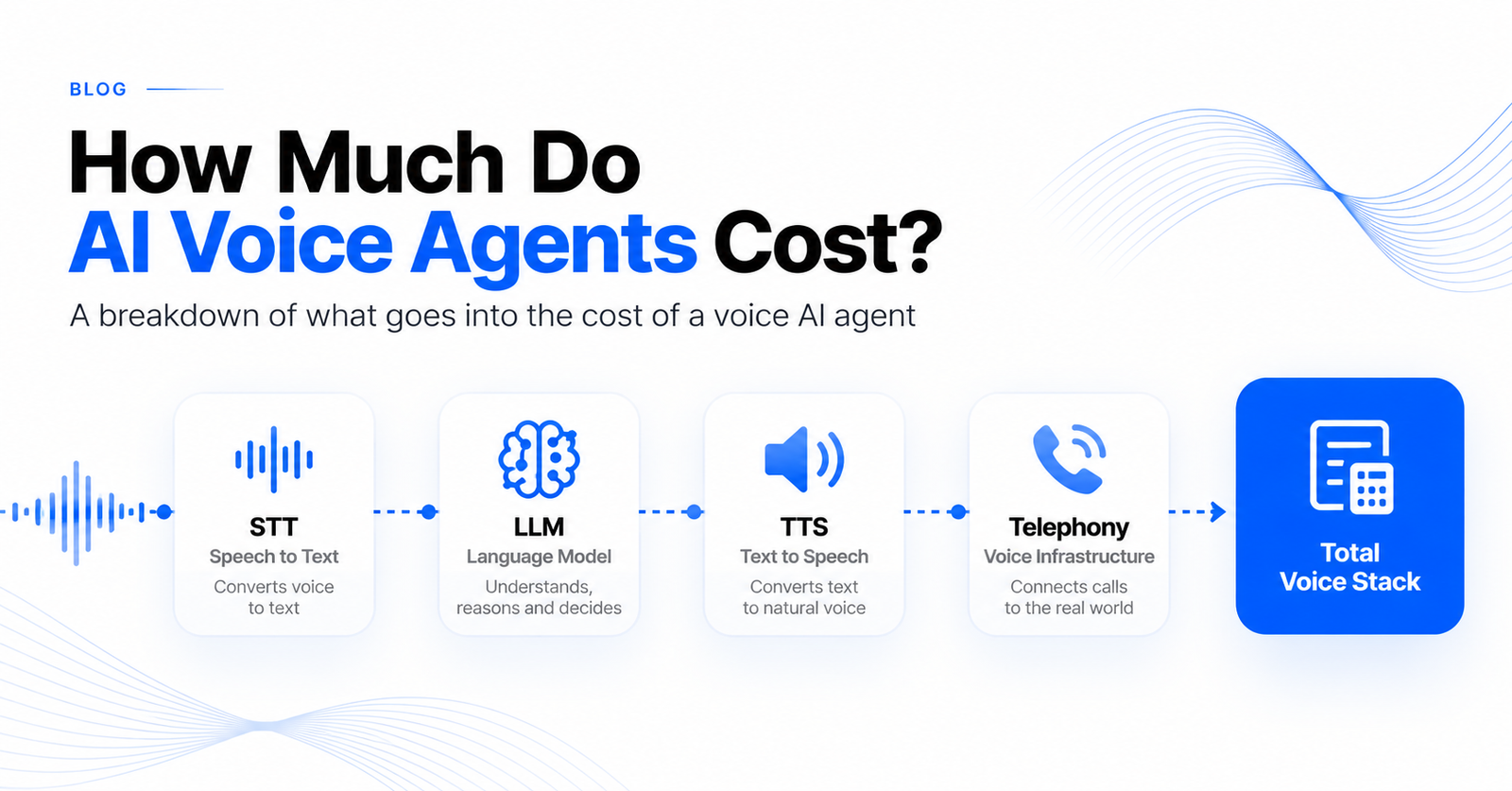
AI voice agent cost is built from four metered components, not one fixed number. It depends almost entirely on four components you can control — speech-to-text (STT), the language model (LLM), text-to-speech (TTS), and telephony — plus whatever margin your vendor adds. A transparent platform lets you see and choose each part; an opaque one bundles them into a round per-minute rate and pockets the spread. This post breaks down exactly what you're paying for, and how to sum current vendor rates into your own number.
For the bigger picture of what these agents do, see the complete guide to AI voice agents. For why transparency itself matters, see per-minute cost transparency.
The four things you actually pay for
Every minute of an AI phone call is the sum of a few metered services:
- Speech-to-text (STT). Transcribes the caller in real time. Usually the cheapest of the four, but accuracy on accents and code-switching varies a lot by provider and language — check your shortlisted vendors' current per-minute STT rate.
- The language model (LLM). Decides what to say and which actions to take. Billed by tokens, so cost scales with how long your prompt and the conversation run and which model tier you pick — a small fast model costs a fraction of a frontier reasoning model per turn.
- Text-to-speech (TTS). Generates the agent's voice. Billed by audio generated, and frequently the single largest line item — the most natural neural voices are compute-heavy per second and cost noticeably more than a basic voice.
- Telephony. Carrying the call over the phone network. Usually the smallest of the four for domestic calls, more for international, and it varies by country, carrier, and whether you bring your own.
Add the four together and you get your all-in per-minute cost: an efficient stack (basic voice, small fast model) sits at the low end; a premium stack (top-tier natural voice + a frontier reasoning model) sits at the high end — sum your shortlisted vendors' current rates for each component to see where your stack lands. Speech-to-speech realtime models are priced differently — you pay for audio in/out rather than three separate services — but the same additive logic applies.
Why the same call can cost 3× more
Two agents doing "the same" call can differ wildly because:
- Voice quality. The most human-sounding TTS costs several times a basic voice. Worth it for brand-facing calls; overkill for an internal reminder.
- Model choice. A frontier LLM reasons better but costs more per token than a small fast model. Simple, scripted flows don't need the expensive model; complex negotiation might.
- Prompt and context size. Long system prompts and large injected context (CRM data, knowledge bases) mean more tokens every turn. Efficient context management is a real cost lever.
- Language. Some languages cost more to transcribe and synthesize well.
This is exactly why per-component pricing matters: you can tune the stack to the job instead of paying premium rates for every call.
The hidden costs to ask about
The sticker per-minute rate is not the whole bill. Watch for:
- Minimum billing increments. Billing rounded up to the next 30 or 60 seconds inflates short calls significantly.
- Time spent on voicemail and no-answers. If the platform can't reliably detect an answering machine, you pay to talk to dial tones. (See how AI agents detect voicemail.)
- Silence and hold time. Are you billed while the caller is on hold or the line is silent?
- Add-ons billed separately. After-call analysis, transcription storage, memory across calls, and premium support may be line items.
- Platform / seat fees. Some vendors charge monthly platform fees on top of usage.
- Markup opacity. A single blended rate hides how much is service cost vs vendor margin.
AI voice agents vs a human agent
The honest comparison isn't per-minute vs per-minute; it's per-productive-minute. A human telecaller is paid for a full shift but spends much of it on breaks, after-call work, dialing, and waiting. Loaded cost per actual talk-minute for a human agent is often several times higher than an AI agent's per-minute rate — before you factor in that AI runs 24/7, handles thousands of parallel calls, and never needs ramp-up. Model your own numbers with a real ROI calculation, but for high-volume, repetitive calling the economics usually favor automation decisively.
The more useful framing: AI handles the routine volume at a fraction of the cost, and your people handle the exceptions. You're not replacing the team; you're removing the calls that shouldn't need a human.
How to estimate your bill
A quick model:
- Estimate average call duration (be honest — include ringing and greetings).
- Multiply by your chosen per-minute stack cost.
- Multiply by connected calls per month (not dials — only connected calls incur most costs).
- Add telephony and any platform fees.
Start with a cheaper stack for simple flows and only upgrade the components that measurably improve outcomes. A platform that shows the per-minute cost of each stack before you launch lets you do this deliberately.
What to insist on from a vendor
- A per-component breakdown, not just a blended rate.
- The exact billing increment and whether silence/hold is billed.
- Voicemail detection quality (it directly affects wasted spend).
- The ability to choose your STT/LLM/TTS so you can tune cost to each use case.
Transparent, model-based pricing is the difference between an invoice you can predict and optimize and one you just have to accept. For how we approach it, see pricing and our take on choosing a voice AI agent.
Written by Callaro Team
Field notes from the team building Callaro's voice AI platform.
Frequently asked questions
How much do AI voice agents cost per minute?+
It's the sum of four metered components — speech-to-text, the language model, text-to-speech, and telephony — so there's no single fixed number. An efficient stack (basic voice, small fast model) lands at the low end; a premium stack with the most natural voice and a frontier reasoning model lands at the high end. Sum your vendor's current per-component rates to get your actual number.
What makes one AI voice agent cost more than another?+
Four things: text-to-speech voice quality, the language model chosen, the size of the prompt/context (more tokens per turn), and the language. Per-component pricing lets you tune each to the job instead of paying premium rates on every call.
What hidden costs should I watch for?+
Minimum billing increments (rounding short calls up), time spent on voicemail/no-answers, whether silence and hold are billed, add-ons like after-call analysis or memory, monthly platform/seat fees, and opaque markup baked into a single blended rate.
Are AI voice agents cheaper than human agents?+
For high-volume, repetitive calling, usually yes — when you compare cost per productive talk-minute rather than per shift. Humans spend much of a shift on breaks, after-call work, and dialing. The common pattern is AI handling routine volume while people handle exceptions.
Related articles

Gemini Live retirement: what changes for voice agents on 17 November
Google retires the Gemini API's preview Live and TTS models on 17 November 2026. Swapping in Gemini 3.8 Live is a one-line change; its new defaults for tool calls, silence and TTS prompts are not. Here is what changes, which date applies on which surface, and how to re-test each agent.

Voice AI for BPOs and contact centers: sell outcomes, not seats
For a BPO, voice AI is a commercial decision before it's a technology one. Put the AI tier where clients get nothing today (overflow, after-hours, callbacks, quality review), price it on resolved outcomes, and work out your containment floor before you quote: a transferred call costs more than a human-only one, so break-even sits higher than most teams assume.

Speech-to-speech vs pipeline voice AI: choose per call, not per platform
Speech-to-speech and pipeline voice agents are no longer separated by latency. After eight days in which every pipeline stage gained a faster model and speech-to-speech systems stopped blocking on reasoning, the choice comes down to which guarantees a call needs. Here is what each path can't do, from running both in production, and a rule for choosing per call type.
See the platform run a real call.
Book a demo and we'll show you outcomes executed end-to-end.
Book a demo