
Best AI voice agent platforms in 2026: an honest comparison
There is no single best AI voice agent platform in 2026 — there's a best one for your use case. Vapi, Retell, Synthflow, Bolna, Ringg.ai, and Callaro all solve the problem differently, trading off developer control, ease of use, transparency, multilingual depth, and white-label. This is a criteria-first comparison so you can pick well, not a leaderboard.
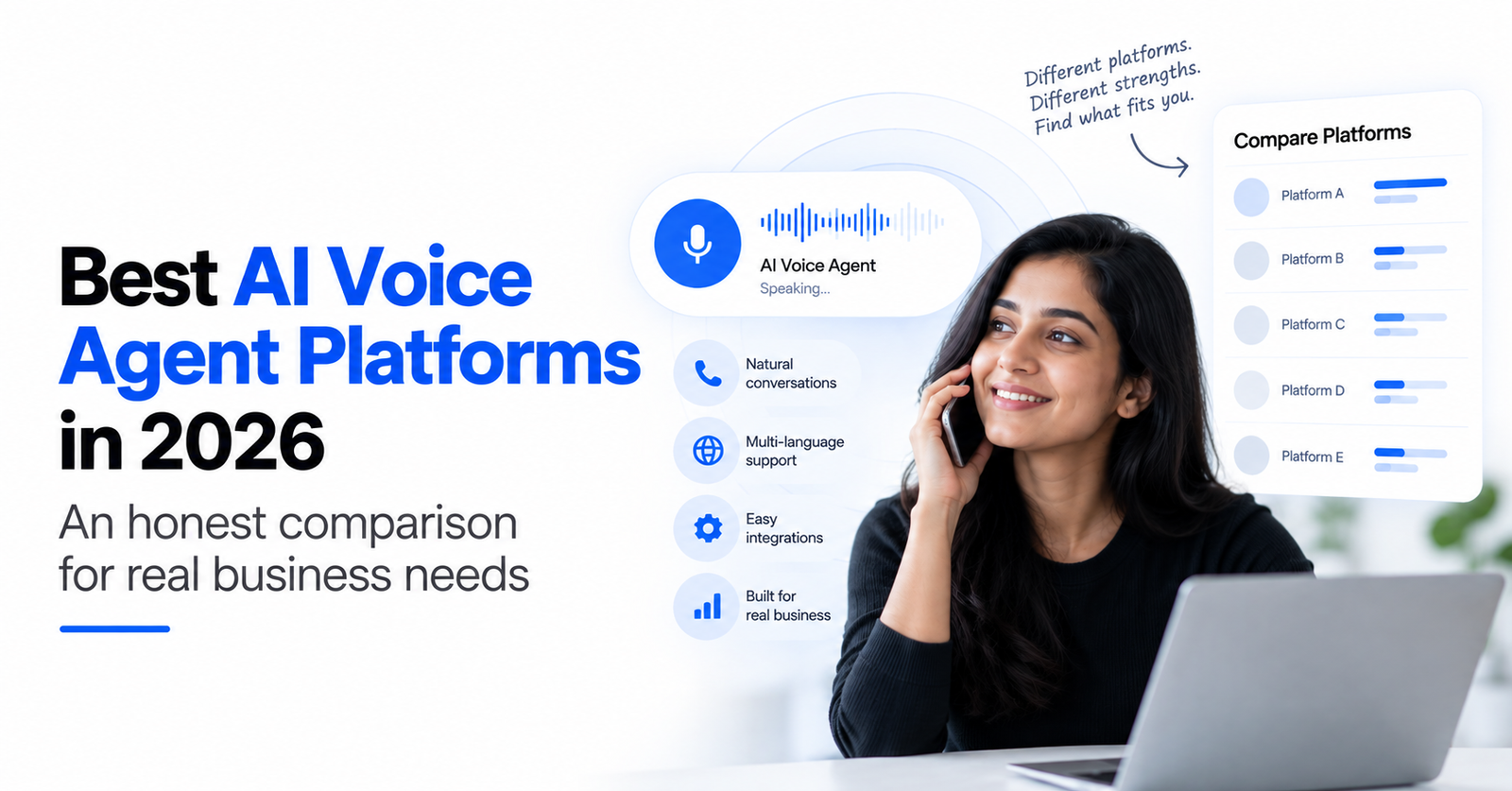
The honest answer to "what's the best AI voice agent platform in 2026?" is that it depends on what you're building. The category has matured into distinct shapes: developer-first infrastructure, no-code builders, region-focused platforms, and white-label platforms for partners. A ranking that ignores your use case is marketing, not guidance. So this is a criteria-first comparison — including where Callaro fits and where it doesn't.
We'll cover how to evaluate any platform, then walk through the main players fairly. For the full buying framework, pair this with our 12-point checklist for choosing an AI voice agent and the complete guide to AI voice agents.
Evaluate by criteria, not by leaderboard
Before looking at names, decide what you're optimizing for. The criteria that separate platforms in practice:
- Developer control vs. no-code. Do you want an SDK and low-level control, or a visual builder your ops team can run?
- Latency and reliability under load — the felt quality of every call, tested on your telephony.
- Model choice — whether you can mix speech-to-text, LLM, and text-to-speech, or use speech-to-speech, and switch as models evolve.
- Multilingual depth — real accent and code-switching handling, not just a language dropdown.
- Orchestration — how the agent takes actions mid-call (tools, APIs, function calling, MCP).
- Pricing transparency — bundled vs. pass-through costs.
- White-label and multi-tenancy — if you resell under your own brand.
- Telephony reach — including regional coverage like Indian carriers.
Weight these to your situation, then test the shortlist on your own scenarios. The rest of this post maps the players onto those criteria.
One caveat worth stating up front: the category moves fast. Platforms ship new model support, change pricing, and add features monthly, and a competitor that lags on one criterion today may lead on it next quarter. So the durable skill isn't memorizing a ranking — it's knowing which criteria matter for you and running your own tests. The 12-point checklist is the tool for that.
The main players in 2026
Brief, fair characterizations. Capabilities change fast, so treat these as starting points and verify against your own tests and each vendor's current docs. Note the recurring pattern: platforms cluster into developer-first infrastructure (maximum control, more assembly required) and no-code builders (fast to launch, less depth at the edges), with regional and white-label focus cutting across both. Knowing which cluster a platform belongs to tells you most of what you need before you even sign up.
Vapi
Vapi is developer-first infrastructure. It's strong when you want low-level control, your own model choices, and to build the orchestration yourself in code. The tradeoff is that you're assembling more of the stack — great for engineering teams, heavier for a non-technical ops team that just wants running campaigns.
Retell
Retell (RetellLabs) focuses on giving developers a clean path to reliable conversational voice agents with good call quality and a solid API. Like Vapi, it leans developer-oriented; teams choose between them largely on API ergonomics, pricing, and the specific model/telephony support they need.
Synthflow
Synthflow leans no-code. Its strength is letting non-engineers build and launch voice agents through a visual interface quickly, which is attractive for SMBs and agencies that value speed of setup over deep customization. The tradeoff is less low-level control when you hit an edge case that the builder doesn't cover.
Bolna
Bolna is an open, developer-oriented platform with strong attention to the Indian market and multilingual calling. It's worth a look if you want flexibility and regional telephony coverage, and are comfortable with a more technical, build-it-yourself posture.
Ringg.ai
Ringg.ai targets fast setup of AI calling for business use cases with multilingual support and a focus on getting campaigns live quickly. Like other no-code-leaning tools, it trades some depth of control for speed and simplicity.
Callaro
Callaro is where we build, so treat this as informed but interested. Callaro is designed around a few deliberate positions:
- Transparency. Clear, itemized pricing rather than a low headline rate with model costs passed through quietly — see AI calling cost transparency and the published pricing.
- Model choice. Mix speech-to-text, LLM, and text-to-speech, or use speech-to-speech, and switch as models evolve — including honest handling of model migrations and sunsets. More at models and languages.
- Orchestration. Taking real actions mid-call — tools, APIs, MCP — is a first-class concern, not an afterthought. See Callaro's orchestration.
- Multilingual depth. Real accent and code-switching handling, covered in multilingual voice AI, accents, and code-switching.
- White-label. Built so partners can ship it as their own product with margin and control.
Where Callaro is not the obvious pick: if you specifically want to assemble everything yourself at the lowest possible level with no opinions imposed, a pure infrastructure play may suit you better. We'd rather tell you that than pretend one platform wins every scenario.
We also cover Indian telephony alongside international carriers, which matters if your calling spans markets — but international reach and local reach are different problems, and it's worth confirming coverage for the specific numbers and regions you'll dial rather than assuming "multilingual" implies "reaches everywhere."
A note on pricing claims
Across the whole category, pricing is where honest comparison gets hardest. Platforms quote in different units — some per minute all-in, some per minute plus pass-through model and telephony charges, some with concurrency or seat tiers layered on. Two "$0.X per minute" quotes can differ by a large margin once you add everything a real month consumes. This is why the fair-comparison step below insists on modeling total cost rather than trusting a headline rate, and why we publish the breakdown in AI calling cost transparency.
Matching platforms to use cases
- You're an engineering team building a custom product: developer-first infrastructure (Vapi, Retell) or Callaro's programmable layer. Weight API control and model choice.
- You're an ops team or SMB wanting agents live fast: no-code-leaning platforms (Synthflow, Ringg.ai) or Callaro's builder. Weight time-to-launch and support.
- You're focused on multilingual or Indian-market calling: platforms with genuine regional depth (Bolna, Callaro). Weight telephony reach and code-switching quality.
- You're a partner or agency reselling under your brand: weight white-label, multi-tenancy, and margin — where Callaro is deliberately positioned.
- You run high-volume outbound: weight concurrency, pacing, voicemail detection, and compliance across every candidate.
A useful sanity check: write down your top three criteria before you look at any platform. If "lowest per-minute rate" is one of them, make sure you're comparing fully-loaded costs — a headline rate that excludes model and telephony charges isn't cheaper, it's just quoted differently. If "white-label" is one, confirm it's real multi-tenancy with your branding and billing control, not a logo swap. The criteria you name first should drive the shortlist; the platform's overall reputation should not.
Voice-only vs omnichannel platforms
A growing split in 2026 is between platforms that do voice well and platforms that run the whole customer journey. If your customers also use WhatsApp, website chat, SMS or email, check whether the same agent and the same customer memory span those channels, whether a call can send a message mid-conversation, and whether your team gets one inbox. Callaro runs one agent across voice, WhatsApp, chat, SMS, RCS, email and an API channel; voice-first tools may need separate products or integrations for the rest.
How to run a fair comparison
Don't decide from comparison tables alone — including this one. Instead:
- Shortlist two or three platforms whose shape matches your use case.
- Run identical test calls on each, on your telephony and in your languages.
- Score against the checklist — latency, voicemail detection, barge-in, orchestration, observability, pricing, concurrency, handoff.
- Model total cost for a realistic month, not a single call — see how much AI voice agents cost.
For head-to-head specifics against named competitors, our comparison pages line up the details, and the choosing checklist gives you the exact questions to ask. The best platform is the one that wins your test calls — so run them.
Written by Callaro Team
Field notes from the team building Callaro's voice AI platform.
Frequently asked questions
What is the best AI voice agent platform in 2026?+
There isn't a single best one — the right choice depends on your use case. Developer teams often favor infrastructure-style platforms like Vapi or Retell; ops teams and SMBs favor no-code-leaning tools like Synthflow or Ringg.ai; teams focused on multilingual or Indian-market calling look at Bolna or Callaro; and partners reselling under their own brand weight white-label heavily. Evaluate by criteria and test on your own calls.
How is Callaro different from Vapi, Retell, Synthflow, Bolna, and Ringg.ai?+
Callaro is positioned on transparent itemized pricing, model choice (mix STT/LLM/TTS or speech-to-speech and switch as models evolve), first-class orchestration for taking actions mid-call, real multilingual depth including code-switching, and white-label for partners. Vapi and Retell lean developer-first infrastructure; Synthflow and Ringg.ai lean no-code and fast setup; Bolna is open and developer-oriented with strong regional focus.
Should I choose a developer-first or no-code voice AI platform?+
Choose developer-first (SDK, low-level control) if you have an engineering team building a custom product and want to control the model stack and orchestration. Choose no-code if an ops team needs agents live quickly through a visual builder. The tradeoff is control versus speed of setup; some platforms offer both a programmable layer and a builder.
How do I compare AI voice agent platforms fairly?+
Shortlist two or three platforms that match your use case, run identical test calls on each using your own telephony and languages, and score them against a consistent checklist — latency, voicemail detection, barge-in, orchestration, observability, pricing transparency, concurrency, and handoff. Then model total cost for a realistic month rather than a single call.
Which voice AI platform is best for multilingual or Indian-market calling?+
Look for platforms with genuine regional depth rather than just a language dropdown — real accent handling, mid-sentence code-switching, and local telephony coverage. Bolna and Callaro both invest in this area. Test with real callers from your market, since generic multilingual support often fails on accented speech and wrong-script transcription.
Do these platform comparisons change quickly?+
Yes. Voice AI capabilities, model support, and pricing evolve fast, and vendors ship frequently. Treat any comparison — including this one — as a starting point, verify current capabilities against each vendor's documentation, and rely most on your own test calls run on the scenarios you actually operate.
Related articles

Gemini Live retirement: what changes for voice agents on 17 November
Google retires the Gemini API's preview Live and TTS models on 17 November 2026. Swapping in Gemini 3.8 Live is a one-line change; its new defaults for tool calls, silence and TTS prompts are not. Here is what changes, which date applies on which surface, and how to re-test each agent.

Voice AI for BPOs and contact centers: sell outcomes, not seats
For a BPO, voice AI is a commercial decision before it's a technology one. Put the AI tier where clients get nothing today (overflow, after-hours, callbacks, quality review), price it on resolved outcomes, and work out your containment floor before you quote: a transferred call costs more than a human-only one, so break-even sits higher than most teams assume.

Speech-to-speech vs pipeline voice AI: choose per call, not per platform
Speech-to-speech and pipeline voice agents are no longer separated by latency. After eight days in which every pipeline stage gained a faster model and speech-to-speech systems stopped blocking on reasoning, the choice comes down to which guarantees a call needs. Here is what each path can't do, from running both in production, and a rule for choosing per call type.
See the platform run a real call.
Book a demo and we'll show you outcomes executed end-to-end.
Book a demo