

AI cold calling in 2026: outbound campaigns that convert
AI cold calling works when you treat it as an operations problem, not a demo. The campaigns that convert nail speed-to-lead, keep lists clean, pace concurrency to protect answer rates, respect call windows, detect voicemail so agents never pitch a machine, and hand warm prospects to humans at the right moment. Here's how to build one.
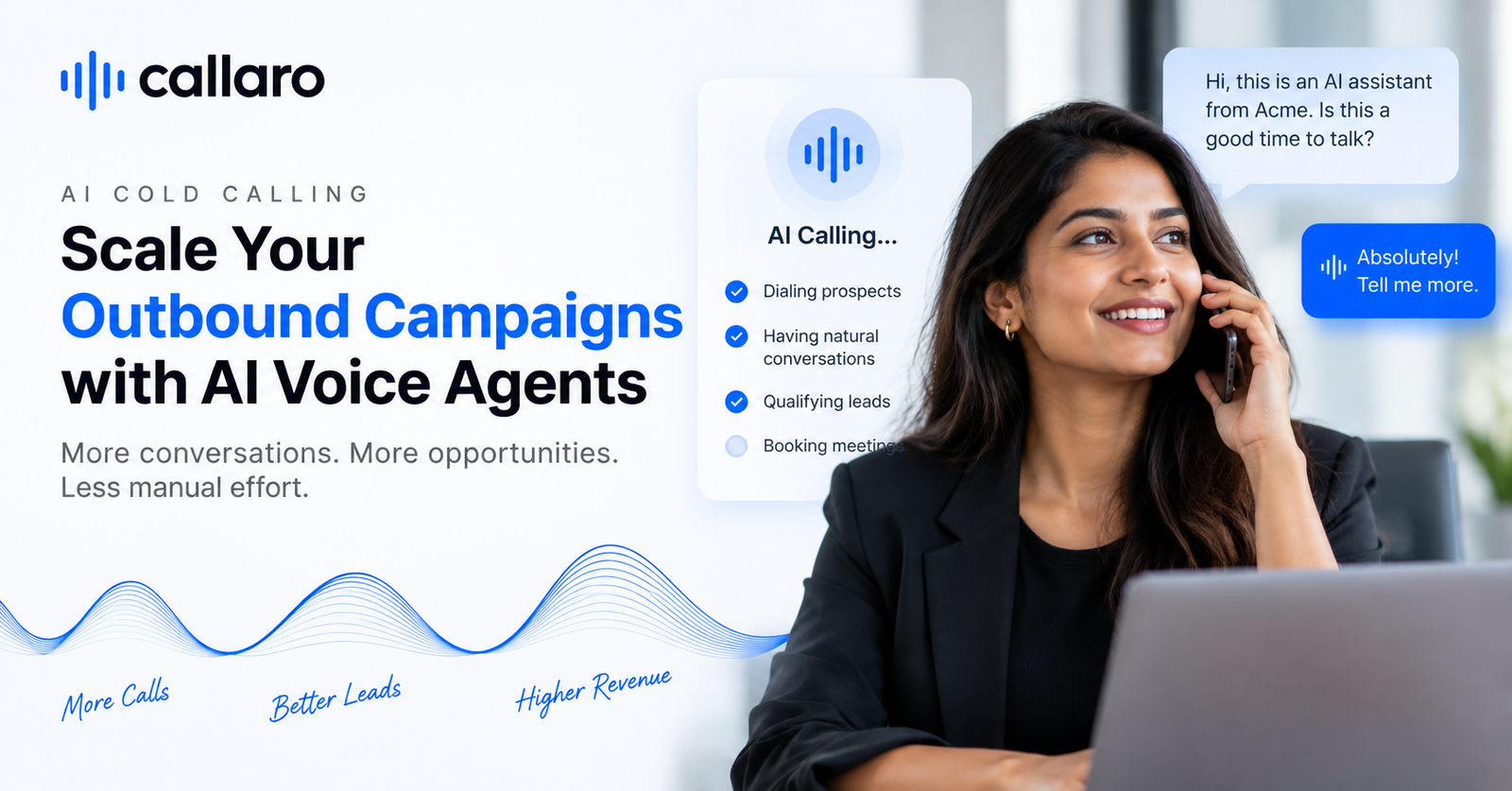
AI cold calling converts when you stop treating it as a clever demo and start treating it as an outbound operation with the same disciplines you'd apply to a human dialing floor: speed-to-lead, list hygiene, pacing, compliant call windows, sharp objection handling, honest voicemail detection, and a clean handoff to humans. The technology has caught up. The programs that win are the ones that get the operational details right.
This is a practical playbook for building an AI outbound campaign that actually moves pipeline, drawn from what separates campaigns that book meetings from campaigns that burn minutes. For the broader picture of what these systems are and how they work, start with our complete guide to AI voice agents.
Lead with speed-to-lead
The single highest-leverage variable in outbound is how fast you call a fresh lead. A prospect who fills a form or abandons a cart is at peak intent for minutes, not hours. Call within the first minute and connect-and-qualify rates are dramatically higher than calling an hour later; wait until the next business day and most of that intent has evaporated.
This is exactly where AI changes the economics. A human team can't reliably dial every inbound lead within sixty seconds around the clock — someone is always in a meeting, at lunch, or asleep. An AI agent can. Wire your lead source (web form, ad, CRM webhook) directly to the dialer so a qualified lead triggers a call almost immediately, then falls back to a retry schedule if the first attempt misses. If you do only one thing from this post, make it this. We go deeper in why 60 seconds decides the deal.
List hygiene decides your answer rate
Garbage lists produce garbage campaigns, and at AI scale they produce garbage fast. Before a campaign runs:
- Validate numbers. Strip malformed, disconnected, and duplicate numbers. Dialing dead numbers wastes concurrency and drags your answer rate down.
- Deduplicate across campaigns. The same person hit by three overlapping campaigns in a week is a complaint waiting to happen.
- Suppress do-not-call and opt-outs. Maintain a live suppression list and check it at dial time, not just at import.
- Segment by intent and recency. A lead from this morning and a cold list from six months ago deserve different scripts, different pacing, and different expectations.
Clean lists also make your metrics trustworthy. If half your "no answer" outcomes are actually dead numbers, you'll misread the campaign entirely.
Pacing and concurrency: protect the answer experience
Concurrency is how many calls your campaign runs at once. It is tempting to crank it to the maximum and blast the list, but pacing is where naive programs quietly self-destruct.
Two forces bound your concurrency. First, your own capacity to handle connects — if calls are meant to warm-transfer to a human team, you can't have more live conversations queued than agents to receive them, or prospects sit on hold and drop. Second, carrier and reputation limits — dialing too aggressively from too few numbers gets your caller IDs flagged as spam, and once a number is flagged, answer rates collapse. Rotate a healthy pool of numbers, keep per-number call volume sane, and ramp concurrency gradually rather than starting at full tilt.
The right setting is a function of list size, connect rate, average handle time, and how many humans (if any) sit downstream. Callaro exposes concurrency and retry pacing as campaign controls precisely because the correct number is different for a 500-lead nurture and a 50,000-lead cold push. If you're running many clients or brands, per-tenant pacing matters even more — see how we orchestrate calls and actions.
Compliance and call windows are not optional
Outbound calling is regulated in most markets, and the rules differ by region, so build compliance into the campaign rather than bolting it on. Region-neutral principles that travel well:
- Respect calling hours. Only dial within locally permitted windows, and compute them against the recipient's time zone, not your server's. A campaign that spans regions needs per-lead window logic.
- Honor do-not-call and opt-out immediately. When someone asks not to be called again, that request must propagate to the suppression list in real time and across every campaign.
- Disclose that it's an automated call where required, and identify who is calling and why.
- Cap attempts. Don't call the same person ten times in a day. Set sane per-lead attempt limits and back off between retries.
Getting this wrong isn't just a fine risk — aggressive, non-compliant dialing torches your number reputation and your brand. Compliant programs are also more effective programs.
Script and objection design
An AI agent is only as good as the conversation you design for it. The best cold-call scripts are short, honest, and built around a single clear goal per call — book a meeting, qualify, or route to a human.
- Open with a reason for the call, fast. People decide whether to stay on the line in the first few seconds. State who you are and why you're calling in one breath.
- Design for objections, not just the happy path. "I'm busy," "who is this," "is this a robot," "send me an email," "not interested" — each deserves a genuine, non-robotic response and a graceful exit or redirect. Map the top ten objections your market throws and script real handling for each.
- Be honest about being AI. Modern voices are natural enough that trying to hide it backfires when discovered. A brief, matter-of-fact acknowledgment builds more trust than a dodge.
- Keep turns tight and let people interrupt. Barge-in handling — letting a prospect cut in mid-sentence — is what makes an agent feel like a conversation instead of a recording.
Voicemail handling: never pitch a machine
A large share of cold calls reach voicemail, and how your agent handles that is a direct cost line. If the agent can't tell a human from an answering machine, it either delivers a perfect pitch to a dial tone or talks over someone's greeting.
This is why answering-machine detection (AMD) matters. A production system fuses carrier-side AMD signals with its own runtime audio classification, and critically, when it detects voicemail it waits for the beep before leaving a message rather than talking over the greeting. Decide up front whether the campaign should leave a voicemail at all (a short, branded message can lift callbacks) or drop and retry later. We wrote a full teardown of this in how AI voice agents detect voicemail — it's the kind of depth worth probing any vendor for.
Warm handoff to humans
For most outbound goals, the AI's job is to earn a human conversation, not replace it. The handoff is where campaigns leak value if you're careless.
A good warm transfer carries context: when the agent routes a qualified prospect to a human rep, the rep should arrive already knowing who they're talking to, what was discussed, and why this lead qualified — not starting cold. That means passing a live summary and the relevant lead fields into the transfer, and only transferring when a human is actually available. If no one's free, capture a callback commitment rather than dumping the prospect into hold music. This same discipline underpins good inbound support — see cutting hold times to zero.
Measuring what matters
Vanity metrics (calls dialed) tell you nothing. Track the funnel:
- Connect rate — of dials, how many reached a human. Sensitive to list quality, number reputation, and call windows.
- Engagement / qualify rate — of connects, how many got past the opener into a real conversation. This measures your script.
- Conversion — meetings booked, transfers accepted, sales made. The number that matters.
- Cost per outcome — total spend divided by conversions, which is where AI's economics usually win versus a human floor.
- Voicemail and drop rates — high numbers here point at AMD tuning or pacing problems.
Review these by segment and by script variant, and A/B test openers and objection handling the way you'd test ad creative. For how these outcomes translate into budget, see how much AI voice agents cost and our pricing.
Putting it together
An AI cold-calling campaign that converts is not a magic script — it's a clean list, dialed fast, paced sensibly, inside legal windows, with a sharp conversation, honest voicemail handling, and a warm handoff to humans who close. Get those right and AI gives you something a human floor never could: every fresh lead called in seconds, all day, at a cost per outcome that actually pencils out.
If you're deciding between platforms for this, our guide to choosing an AI voice agent covers the questions that separate a demo from a system that survives a real campaign.
Written by Callaro Team
Field notes from the team building Callaro's voice AI platform.
Frequently asked questions
Does AI cold calling actually convert, or is it just for volume?+
It converts when run as a disciplined operation. The biggest lever is speed-to-lead — calling fresh leads within seconds while intent is high, which AI can do around the clock in a way a human floor cannot. Combined with clean lists, sensible pacing, sharp scripts, and a warm handoff to human closers, AI outbound can beat a manual floor on cost per outcome.
What is speed-to-lead and why does it matter so much?+
Speed-to-lead is how fast you call a lead after they show intent (a form fill, an ad click, a cart abandon). Intent decays in minutes, so calling within the first minute produces far higher connect-and-qualify rates than calling an hour or a day later. AI agents can trigger a call almost instantly from a lead source, which is where they most obviously outperform human teams.
How do I keep AI outbound calls compliant?+
Build compliance into the campaign: only dial within locally permitted calling hours computed against the recipient's time zone, honor do-not-call and opt-out requests in real time across all campaigns, disclose automated calling where required, and cap attempts per lead. Rules differ by region, so treat these as configurable per market rather than one global setting.
How does an AI agent handle voicemail on outbound calls?+
A production system uses answering-machine detection (AMD) that fuses carrier signals with its own audio classification. When it detects voicemail, it waits for the beep before leaving a message instead of talking over the greeting. You configure whether to leave a branded message or drop and retry. Poor voicemail handling wastes minutes and lowers callback rates.
What should a warm handoff to a human include?+
A good warm transfer passes context — who the prospect is, what was discussed, and why they qualified — so the human rep arrives informed rather than cold. It should only fire when a human is actually available; otherwise the agent should capture a callback commitment rather than leaving the prospect on hold.
Which metrics should I track for an AI cold-calling campaign?+
Track the funnel, not vanity volume: connect rate (list and reputation quality), engagement or qualify rate (script quality), conversion (meetings, transfers, sales), cost per outcome, and voicemail/drop rates. Review by segment and A/B test openers and objection handling like ad creative.
Related articles

Voice AI for BPOs and contact centers: sell outcomes, not seats
For a BPO, voice AI is a commercial decision before it's a technology one. Put the AI tier where clients get nothing today (overflow, after-hours, callbacks, quality review), price it on resolved outcomes, and work out your containment floor before you quote: a transferred call costs more than a human-only one, so break-even sits higher than most teams assume.

Omnichannel AI agents explained: test the seams, not the channel list
An omnichannel AI agent is one agent with one memory per customer, serving calls, WhatsApp, chat, SMS, RCS and email, and able to act across them mid-conversation. Every vendor now claims that, so the label tells you little. What separates platforms is the six seams where a journey crosses channels: identity, memory, action, events, people and consent. Here's what breaks at each, and how to test it.

Voice AI for home services: triage first, book second
In home services, a voice AI agent earns its place on the calls nobody can pick up, and its first job on those calls is triage, with booking second. Sort every call into one of four lanes (safety, emergency dispatch, routine booking, not a new job), give each its own ending, and design for the moment the on-call phone doesn't answer.
See the platform run a real call.
Book a demo and we'll show you outcomes executed end-to-end.
Book a demo