

AI voice agents for real estate: qualify leads & book site visits
An AI voice agent for real estate calls every new portal and web lead within seconds — qualifying budget, location and intent, booking site visits straight into your team's calendar, and chasing undecided buyers until they commit. The result: faster speed-to-lead, more site visits booked, and no hot enquiry left to go cold overnight.
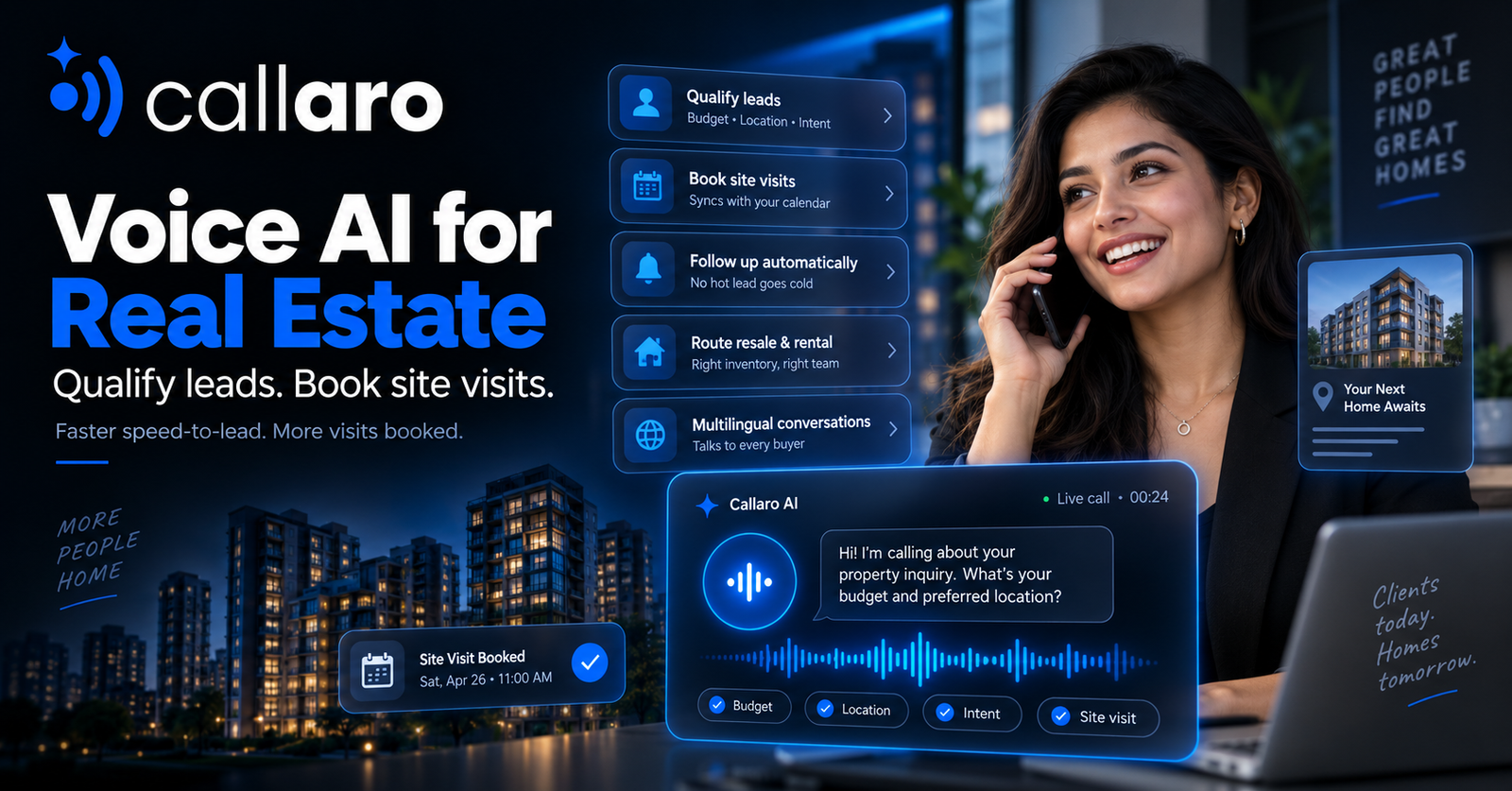
AI voice agents for real estate: qualify leads & book site visits
An AI voice agent for real estate is software that calls every new lead the moment it lands — from portals, ads or your website — and holds a natural conversation to qualify budget, preferred location, configuration and buying intent, then books a site visit directly into your sales team's calendar. For developers, brokerages and agents, the outcome is what the whole industry chases: near-instant speed-to-lead, more site visits booked, and persistent follow-up on undecided buyers, so no hot enquiry sits in a queue going cold while a rep is out showing a property.
This guide covers the highest-impact use cases for property teams, a transparent ROI model, the benchmarks that show it is working, how it plugs into your CRM, and the quality guardrails to set. Start with our complete guide to AI voice agents for fundamentals, then see a property-specific rollout on our real estate solutions page.
Why speed-to-lead decides the deal
In real estate, the first team to reach a buyer usually wins the conversation. A portal enquiry submitted at 9pm, called back at 11am the next morning, is often already talking to three other agents. Human teams simply cannot dial every lead within seconds around the clock — but an AI voice agent can. It calls the instant a lead arrives, qualifies while intent is at its peak, and books the site visit before a competitor even opens the enquiry. That structural speed advantage is the single biggest reason property teams adopt voice AI, and it is the through-line of every use case below. For the outbound mechanics behind this, see our guide to AI cold calling and outbound campaigns.
Top use cases for voice AI in real estate
- Instant portal and web lead qualification. Every enquiry triggers an immediate call that captures budget band, location, configuration (e.g. 2 vs 3 bedroom), timeline and financing status, then scores and routes the lead. Reps wake up to qualified conversations, not raw form-fills.
- Site-visit booking. Qualified buyers are offered real slots and booked straight into the sales calendar, with confirmation and reminder calls to cut no-shows — the same reminder discipline that keeps other industries' calendars full.
- Persistent follow-up on undecided buyers. Most buyers do not commit on the first touch. The agent runs a patient, polite follow-up cadence over days and weeks, re-engaging warm-but-not-ready leads that a busy human pipeline would otherwise drop. This is the same 'don't let value leak out of the funnel' logic behind recovering abandoned carts with voice AI.
- Resale and rental routing. Enquiries are triaged by type — new launch, resale, rental, commercial — and routed to the right team or channel partner automatically.
- Multilingual buyer nurture. Property buyers often prefer their own language. The agent switches languages and handles code-switching mid-call, which matters in multilingual markets; see multilingual voice AI.
A savings / ROI model you can check yourself
Model it with your own numbers rather than trusting a headline. The method is the point.
Inputs:
- Lead volume per month (V) — say 6,000 portal and web leads across projects.
- Average call time (AHT) — say 4 minutes per connected qualification call.
- Loaded pre-sales / tele-calling cost — wages, benefits, supervision, telephony — this is your fully loaded tele-calling-minute rate, and it typically runs several times higher than a metered AI-agent minute. Pull your own number from payroll and overhead rather than a generic figure.
- AI cost per minute is the sum of four metered components — STT, the LLM, TTS, and telephony — and lands well below a loaded tele-calling minute. The exact number depends on which models and telephony you pick, so check current rates on your vendor's pricing page rather than assuming a fixed figure.
The math: if 6,000 leads average even one 4-minute qualification attempt, that is 24,000 minutes/month.
- At your loaded human rate, multiply it by these 24,000 minutes to see the monthly cost — and in practice humans cannot call all 6,000 fast enough, so many are never reached in time.
- Run the same 24,000 minutes at your AI vendor's current per-minute rate and compare: in illustrative runs with realistic assumptions, teams typically see this line item fall by roughly a third to a half, and every single lead gets called within seconds, plus multiple follow-up attempts.
The direct per-minute saving is real, but in real estate the dominant return is conversion: reaching 100% of leads instantly and following up persistently typically lifts the number of site visits booked far more than any labour saving. One extra booking that becomes a sale dwarfs the call cost. Plug your own lead volume, call time and loaded cost into `(V x AHT x rate)` for each side, then weigh it against your site-visit-to-sale value. See pricing for per-minute plans and our guide to AI voice agent costs.
Book a demo and we will build this model with your lead volumes and booking values.
Benchmarks: what good looks like for real estate voice AI
Hold the deployment to a metric framework. These telephony target ranges are illustrative starting points, not promises.
- Speed-to-lead. Time from lead arrival to first call attempt. The target is under a minute — often just seconds — which is the metric where AI structurally beats any human team.
- Connect / right-party contact rate. Share of dials that reach the buyer. Immediate calls to fresh leads connect far better than delayed callbacks; well-timed dialing commonly lands in the range of 30–55% on fresh portal leads, with retries and local caller ID improving it.
- Qualification rate. Share of connected calls that yield a usable qualification (budget, location, timeline, intent) — the input reps actually care about.
- Site visits booked per 100 leads. The commercial north star. Track it before and after, since instant contact plus persistent follow-up is designed to move exactly this number.
- No-show rate on booked visits. Reminder calls should keep this low; measure it against your pre-AI baseline.
- CSAT / sentiment and latency. Watch post-call sentiment and time-to-first-audio; sub-second response keeps the conversation natural and buyers engaged.
How it works and what it integrates with
A real estate voice agent lives or dies by its CRM connection. In practice it integrates with your CRM and lead sources (portals, web forms, ad platforms) so it can fire the instant a lead arrives, pull project and inventory context, write qualification data and call outcomes back to the lead record, and book visits against the right rep's calendar.
Mid-call it orchestrates real actions — offering genuine calendar slots, sending brochures or location links over SMS or WhatsApp, capturing requirements, and warm-transferring a hot, qualified buyer to a live sales rep with full context — instead of reading a static script. Our orchestration engine is what makes those actions and handoffs reliable. Callaro also supports Indian telephony alongside international carriers, which matters for property teams running large domestic lead books, and it handles multilingual, code-switching buyer conversations natively.
A quality and compliance note
Even though property calls are lower-stakes than financial or medical ones, quality discipline protects your brand and keeps you within the rules — align specifics with your local regulations.
- Calling hours and consent. Dial only within permitted local windows, honour do-not-call and opt-out lists, and call only leads you have a lawful basis to contact.
- Disclosure. Where required, disclose that the buyer is speaking with an automated assistant and that the call may be recorded.
- Handoff quality. The moment a buyer is hot or asks something the agent should not answer (legal, pricing negotiation, contractual), transfer to a human rep with full context — a smooth handoff is part of a good experience.
- Audit logs. Keep recordings, transcripts and outcome logs so you can review conversations for quality and coach the script over time.
How to roll it out across your sales team
The developers and brokerages that win with voice AI start focused and scale on results.
- Point it at your fastest-moving lead source first — usually portal or paid-ad enquiries, where speed-to-lead matters most and the volume is highest.
- Run a controlled pilot on those leads for a few weeks, with sales managers reviewing transcripts and confirming qualified leads and bookings flowed into the CRM correctly. Tune the qualification questions, the follow-up cadence and the handoff trigger from real conversations.
- Compare against a matched control group of human-handled leads so you can see the lift in connect rate, speed-to-lead and site visits booked honestly.
- Dial in the follow-up cadence. Undecided buyers convert on persistence — set how many attempts, over how many days, and when to hand off or pause, then refine from the data.
- Expand to more projects and channels — resale, rental, other campaigns — once the first is stable, reusing the same CRM integration and guardrails.
- Keep reps focused on closing. The agent qualifies and books; humans do the showings, negotiation and relationship-building where they add the most value.
Each stage produces its own before-and-after numbers, so the rollout proves itself as it grows. If you are still comparing platforms, our guide to choosing an AI voice agent covers the questions that matter for outbound-heavy teams.
The bottom line
For real estate, an AI voice agent is a speed-to-lead machine: it calls every enquiry in seconds, qualifies it, books the site visit, and keeps following up on the undecided — so your reps spend their time with buyers who are ready, and no hot lead goes cold in a queue. Model the ROI against your booking values, hold it to the benchmarks above, and keep the handoffs clean.
Want to see it on your lead flow? Book a demo or explore the real estate solution in detail.
Written by Callaro Team
Field notes from the team building Callaro's voice AI platform.
Frequently asked questions
What can an AI voice agent do for a real estate team?+
It calls every new portal, web or ad lead within seconds, qualifies budget, location, configuration and intent, books site visits into your reps' calendars, follows up persistently on undecided buyers, routes resale and rental enquiries, and nurtures buyers in their own language — writing everything back to your CRM.
Why is speed-to-lead so important in real estate?+
The first team to reach a buyer usually wins the conversation, and buyer intent is highest right after they enquire. Human teams cannot dial every lead within seconds around the clock, but an AI voice agent can — calling instantly, qualifying while intent peaks, and booking the site visit before competitors even open the enquiry.
How much can voice AI save or earn a property business?+
An AI minute is the sum of four metered components — STT, LLM, TTS and telephony — and typically costs a fraction of a loaded tele-calling minute, so per-minute cost drops. But the dominant return is conversion: reaching 100% of leads instantly and following up persistently usually lifts site visits booked far more than any labour saving, and one extra booking that becomes a sale outweighs the call cost. Model it as lead volume times call time times your current vendor rate, against your booking value.
Which metrics show whether a real estate voice agent is working?+
Track speed-to-lead (target under a minute), connect / right-party contact rate, qualification rate, site visits booked per 100 leads, no-show rate on booked visits, and CSAT/sentiment plus telephony latency. Site visits booked is the commercial north star — measure it before and after.
Does it integrate with our CRM and lead sources?+
Yes. A production voice agent connects to your CRM and lead sources (portals, web forms, ad platforms) so it fires the instant a lead arrives, pulls project and inventory context, writes qualification data and outcomes back to the lead record, books visits against the right rep, and warm-transfers hot buyers with full context.
Can it handle multiple languages and Indian telephony?+
Yes. Callaro supports Indian telephony alongside international carriers and handles multilingual, code-switching buyer conversations natively, which is valuable for property teams working across languages and running large domestic lead books.
Related articles

Gemini Live retirement: what changes for voice agents on 17 November
Google retires the Gemini API's preview Live and TTS models on 17 November 2026. Swapping in Gemini 3.8 Live is a one-line change; its new defaults for tool calls, silence and TTS prompts are not. Here is what changes, which date applies on which surface, and how to re-test each agent.

Voice AI for BPOs and contact centers: sell outcomes, not seats
For a BPO, voice AI is a commercial decision before it's a technology one. Put the AI tier where clients get nothing today (overflow, after-hours, callbacks, quality review), price it on resolved outcomes, and work out your containment floor before you quote: a transferred call costs more than a human-only one, so break-even sits higher than most teams assume.

Omnichannel AI agents explained: test the seams, not the channel list
An omnichannel AI agent is one agent with one memory per customer, serving calls, WhatsApp, chat, SMS, RCS and email, and able to act across them mid-conversation. Every vendor now claims that, so the label tells you little. What separates platforms is the six seams where a journey crosses channels: identity, memory, action, events, people and consent. Here's what breaks at each, and how to test it.
See the platform run a real call.
Book a demo and we'll show you outcomes executed end-to-end.
Book a demo