

AI voice agents for logistics & supply chain: keep every shipment moving
An AI voice agent for logistics keeps shipments moving by automating the phone work that decides your on-time and first-attempt delivery rates: pre-dispatch delivery verification, a 24/7 driver hotline for delays and gate codes, address correction, COD amount confirmation, and high-volume driver and warehouse hiring screens. It runs 24/7, in the caller's language, at a fraction of a loaded human cost per call. Here are the use cases, a savings model, and the benchmarks that prove it out.
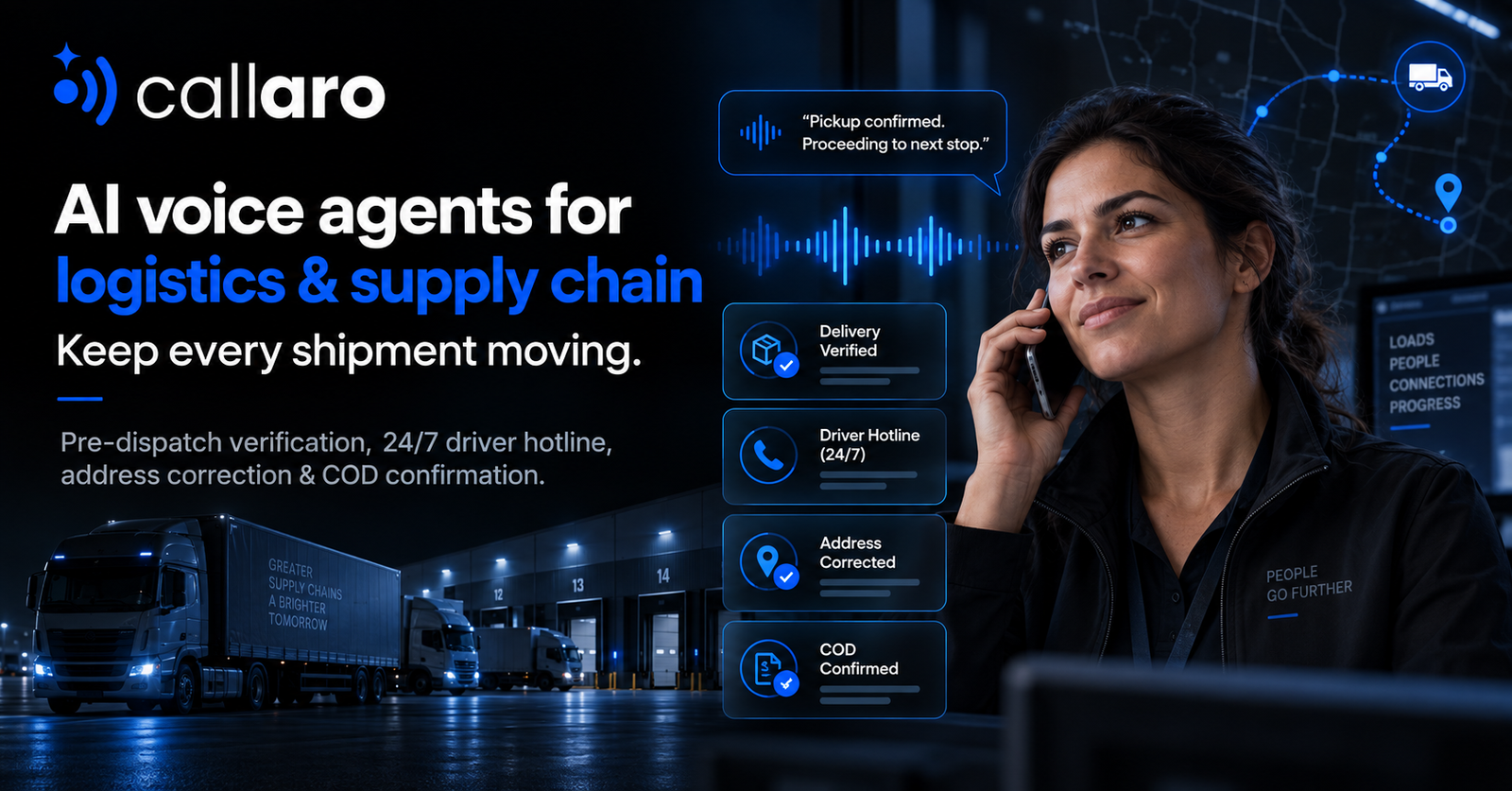
An AI voice agent for logistics keeps shipments moving by automating the phone work that decides your on-time and first-attempt delivery rates — verifying deliveries before dispatch, running a 24/7 hotline for drivers stuck on delays or gate codes, correcting bad addresses, confirming cash-on-delivery amounts, and screening high volumes of driver and warehouse applicants. It works around the clock, in the caller's language, and costs a small fraction of a loaded human cost per call — so no shipment stalls just because your ops desk is at capacity or it's 2 a.m.
This playbook covers the logistics-specific use cases, a savings model you can run with your own numbers, the benchmarks that tell you it's working, how it integrates, and the compliance discipline to keep in mind. New to the category? Start with the complete guide to AI voice agents, then come back for the supply-chain specifics.
The five use cases that keep freight moving
1. Pre-dispatch delivery and availability verification
A failed first delivery is one of the most expensive events in last-mile: a wasted trip, a re-attempt, and often a return-to-origin. An outbound agent calls the recipient before the vehicle leaves — confirming they'll be available in the window, verifying the address, and rescheduling proactively if not. Catching a bad slot the evening before turns a wasted run into a right-first-time delivery.
2. Driver dispatch hotline for delays and gate codes
Drivers hit blockers in real time — a locked gate, a missing dock code, a customer not answering, a route change. A voice agent answers that hotline instantly, 24/7, looks up the stop, provides the gate or access code, reschedules or reroutes, and escalates to a human dispatcher only when it genuinely needs one. It removes the hold queue that leaves drivers idling and shipments waiting.
3. Address correction
Bad and incomplete addresses are a top cause of delivery failure. When an address looks wrong or a delivery bounces, the agent calls the recipient, confirms the correct address and landmark, captures delivery instructions, and updates the record — before another attempt is wasted.
4. COD amount confirmation
In cash-on-delivery markets, mismatched or unconfirmed COD amounts drive disputes, refusals and RTO losses. The agent confirms the exact amount and the recipient's intent to pay on delivery before dispatch, flagging the orders that don't confirm so they never take up a slot on the vehicle.
5. High-volume driver and warehouse hiring screens
Logistics hiring is a volume game — hundreds of applicants, mostly first-round phone screens. A voice agent calls every applicant fast, runs the structured screen (licence class, availability, location, right-to-work basics), and books qualified candidates straight into an interview slot. Recruiters stop chasing no-shows and start with a shortlist.
The savings model: run your own numbers
Don't take a headline percentage on trust — build the model.
Human cost per call = average handle time (minutes) × loaded agent cost per minute (wages plus benefits, management, tooling, facilities — well above base wage).
AI cost per call = average handle time (minutes) × per-minute AI rate — the sum of STT, LLM, TTS and telephony, which you can check on your vendor's pricing page, depending on model, telephony and language.
Take a delivery-verification call averaging 3 minutes — plug in your fully loaded human cost per minute and your AI vendor's rate to compare:
- Human: 3 min × your loaded human rate per minute = your human cost per call
- AI: 3 min × your vendor's AI rate per minute = your AI cost per call
That's roughly a 4–5x cost-per-call difference — but in logistics the operational savings dwarf the call cost. Each prevented failed delivery avoids a re-attempt trip and possible RTO, which can run many times the price of the verification call itself. So size it as: (call-handling cost saved on volume you already run) + (failed-delivery and RTO costs avoided) + (recruiter hours freed and time-to-hire cut). Show the arithmetic, frame everything as ranges, and the case is usually decisive. Firm up the per-minute figure with how much AI voice agents cost and our pricing.
Book a demo and we'll build this model against your own delivery volume and failure rates.
The benchmarks that tell you it's working
Set targets before launch. The ranges below are illustrative telephony starting points, not guarantees — your routes, timezones and language mix will move them.
- Connect rate (outbound) — share of dials reaching a live recipient. Verification and address-correction calls respond well to timezone-aware calling and sensible retries; a low connect rate is usually list quality or timing, not the agent.
- First-attempt delivery rate (business outcome) — the number this whole play exists to lift. Track it before and after; verified, address-corrected deliveries should attempt right the first time far more often.
- Containment / deflection rate (driver hotline) — share of driver calls fully resolved without a human dispatcher. Well-scoped gate-code and reschedule flows contain most routine calls and escalate the rest cleanly.
- Speed-to-answer (hotline) — how fast a calling driver gets a response. A 24/7 agent answers instantly, which is the whole point versus a queue.
- Latency / time-to-first-audio — sub-second, natural turn-taking matters even more with drivers on hands-free in noisy cabs.
- Time-to-hire / screen-completion rate (recruiting) — how quickly applicants are screened and how many complete the screen; both should improve sharply at volume.
Our notes on cutting hold times with 24/7 AI phone support cover how the inbound-hotline numbers move once it's automated, and AI cold calling and outbound campaigns covers the outbound verification and screening side at scale.
How it works: integrations and orchestration
The agent has to reach your operational systems to be useful:
- Trigger — a shipment queued for dispatch, an inbound driver call, a bounced address, or a new applicant fires the agent.
- Context — it pulls the shipment, stop, route or candidate record from your TMS, OMS, WMS or ATS via API.
- Conversation — it talks naturally, understands intent, and takes real actions mid-call: confirming or rescheduling a delivery window, reading back a gate code, updating an address, flagging a COD mismatch, or booking an interview slot.
- Handoff & logging — anything out of scope routes to a human dispatcher or recruiter with full context, and every call is transcribed and written back to your system of record.
Doing those mid-call actions reliably, and picking the right model for latency and language, is the orchestration layer — see how our agents take real actions mid-call.
Compliance and quality notes
Outbound calling is regulated in most markets, so keep the discipline region-neutral. Respect calling-hours windows and do-not-call lists for recipient-facing calls, honour opt-outs immediately, and disclose that the caller is an AI where required. For hiring screens, keep the questions job-relevant and lawful, and route anything approaching a hiring decision to a human recruiter rather than letting the agent decide. Never collect full payment-card or bank-account numbers by voice — confirm COD amounts and intent, but route any actual payment to a secure link. Record and retain transcripts for QA, dispute resolution and hiring audit trails, and check the specific rules in each market with your compliance team.
Why voice, when you already have tracking links and SMS
Tracking links and status texts are fine for one-way updates, but logistics runs on two-way, time-critical exchanges that text handles badly. A driver stuck at a locked gate needs an answer in seconds, not a support ticket. A recipient with a wrong address needs to be reached and corrected before the vehicle rolls. A customer who won't be home needs to reschedule now, not after the failed attempt. Voice resolves these in one live exchange, which is why it sits alongside — not instead of — your notification stack. The pattern is usually an automated SMS for passive updates, and a voice call the moment something needs confirming, correcting or rescheduling.
Peak surges and multilingual crews
Logistics volume spikes hard — a sale event, a holiday, a weather disruption rerouting hundreds of stops — and that's exactly when the ops desk and driver hotline jam. A voice agent scales to concurrent calls instantly through a surge and scales back after, with no overtime or temporary hiring. It also serves drivers and recipients in their own language, which matters for a workforce and customer base that are rarely monolingual; a driver on a hands-free headset in a noisy cab is far better served by an agent that speaks their language and responds in well under a second. For how the agent handles accents and language switching mid-call, see multilingual voice AI, accents and code-switching.
Where to start
Don't automate the whole operation at once. Pick the single play with the clearest operational payback — for most carriers that's pre-dispatch verification (fewer failed deliveries) or the driver hotline (no idle drivers) — and run a bounded pilot: one flow, one depot or lane, tight scope, and clean escalation to a human dispatcher. Measure first-attempt delivery rate and hotline containment against pre-set targets. Once proven, extend to address correction, COD confirmation and hiring screens. Staging it de-risks the rollout and gives you a defensible savings and delivery-performance figure at each step.
The bottom line
An AI voice agent for logistics protects your delivery performance and lowers cost-to-serve at once: it saves roughly 4–5x per handled call while preventing the failed deliveries, RTO losses and idle-driver hold times that cost far more than any call. Start with pre-dispatch verification and the driver hotline — the two plays with the clearest operational payback — prove the model, then extend into address correction, COD confirmation and hiring.
See the full picture on our logistics solutions page, and when you want to see it run against your own shipment and route data, book a demo.
Written by Callaro Team
Field notes from the team building Callaro's voice AI platform.
Frequently asked questions
What is an AI voice agent for logistics?+
It's a conversational phone agent that automates a carrier or supply-chain operation's high-volume calls — pre-dispatch delivery verification, a 24/7 driver hotline for delays and gate codes, address correction, COD amount confirmation, and driver and warehouse hiring screens — 24/7 and in the caller's language, integrated with your TMS, OMS, WMS or ATS so it can reschedule, read back gate codes, and update records mid-call.
How much can a logistics operation save with a voice AI agent?+
Build the model: human cost per call is handle time times loaded agent cost per minute; AI cost is handle time times your vendor's per-minute rate, which combines STT, LLM, TTS and telephony and lands well below a loaded human minute. For a 3-minute verification call that is often several times cheaper per call — but the bigger savings are operational: each prevented failed delivery avoids a re-attempt trip and possible return-to-origin that costs many times the call. Add recruiter hours saved and size it against your own volume and failure rates.
Can a voice agent run a 24/7 driver hotline?+
Yes. It answers instantly around the clock, looks up the driver's stop, provides gate or access codes, reschedules or reroutes, and escalates to a human dispatcher only when it genuinely needs one. That removes the hold queue that otherwise leaves drivers idling and shipments waiting during off-hours or peak.
How does voice AI reduce failed deliveries?+
By calling the recipient before dispatch to confirm availability in the window and verify the address, and by calling to correct addresses that look wrong or have already bounced. Catching a bad slot or address the evening before turns a wasted trip into a right-first-time delivery, which is the single biggest operational lever in last-mile.
Can a voice agent screen driver and warehouse applicants?+
Yes, for high-volume first-round screens. It calls every applicant quickly, runs a structured, job-relevant screen (licence class, availability, location, right-to-work basics), and books qualified candidates into an interview slot. Keep any actual hiring decision with a human recruiter; the agent handles the volume and the shortlist, not the judgement.
How does the agent connect to my TMS or WMS?+
Through APIs. On a trigger — a shipment queued for dispatch, an inbound driver call, a bounced address, or a new applicant — it pulls the shipment, stop, route or candidate record from your transport, order, warehouse or applicant-tracking system, acts on it during the call, and writes the transcript and outcome back to your system of record.
Related articles

Gemini Live retirement: what changes for voice agents on 17 November
Google retires the Gemini API's preview Live and TTS models on 17 November 2026. Swapping in Gemini 3.8 Live is a one-line change; its new defaults for tool calls, silence and TTS prompts are not. Here is what changes, which date applies on which surface, and how to re-test each agent.

Voice AI for BPOs and contact centers: sell outcomes, not seats
For a BPO, voice AI is a commercial decision before it's a technology one. Put the AI tier where clients get nothing today (overflow, after-hours, callbacks, quality review), price it on resolved outcomes, and work out your containment floor before you quote: a transferred call costs more than a human-only one, so break-even sits higher than most teams assume.

Omnichannel AI agents explained: test the seams, not the channel list
An omnichannel AI agent is one agent with one memory per customer, serving calls, WhatsApp, chat, SMS, RCS and email, and able to act across them mid-conversation. Every vendor now claims that, so the label tells you little. What separates platforms is the six seams where a journey crosses channels: identity, memory, action, events, people and consent. Here's what breaks at each, and how to test it.
See the platform run a real call.
Book a demo and we'll show you outcomes executed end-to-end.
Book a demo