

AI voice agents for insurance: renewals, claims & lead qualification
An AI voice agent for insurance automates the high-volume phone work that decides your loss ratio and retention: policy-renewal reminders and premium collection, new-lead qualification, claim intimation and status, KYC and document follow-ups, and lapsed-policy reactivation — 24/7 and in the customer's language, at a fraction of a loaded human cost per minute. Here are the use cases, a savings model, and the benchmarks that prove it out.
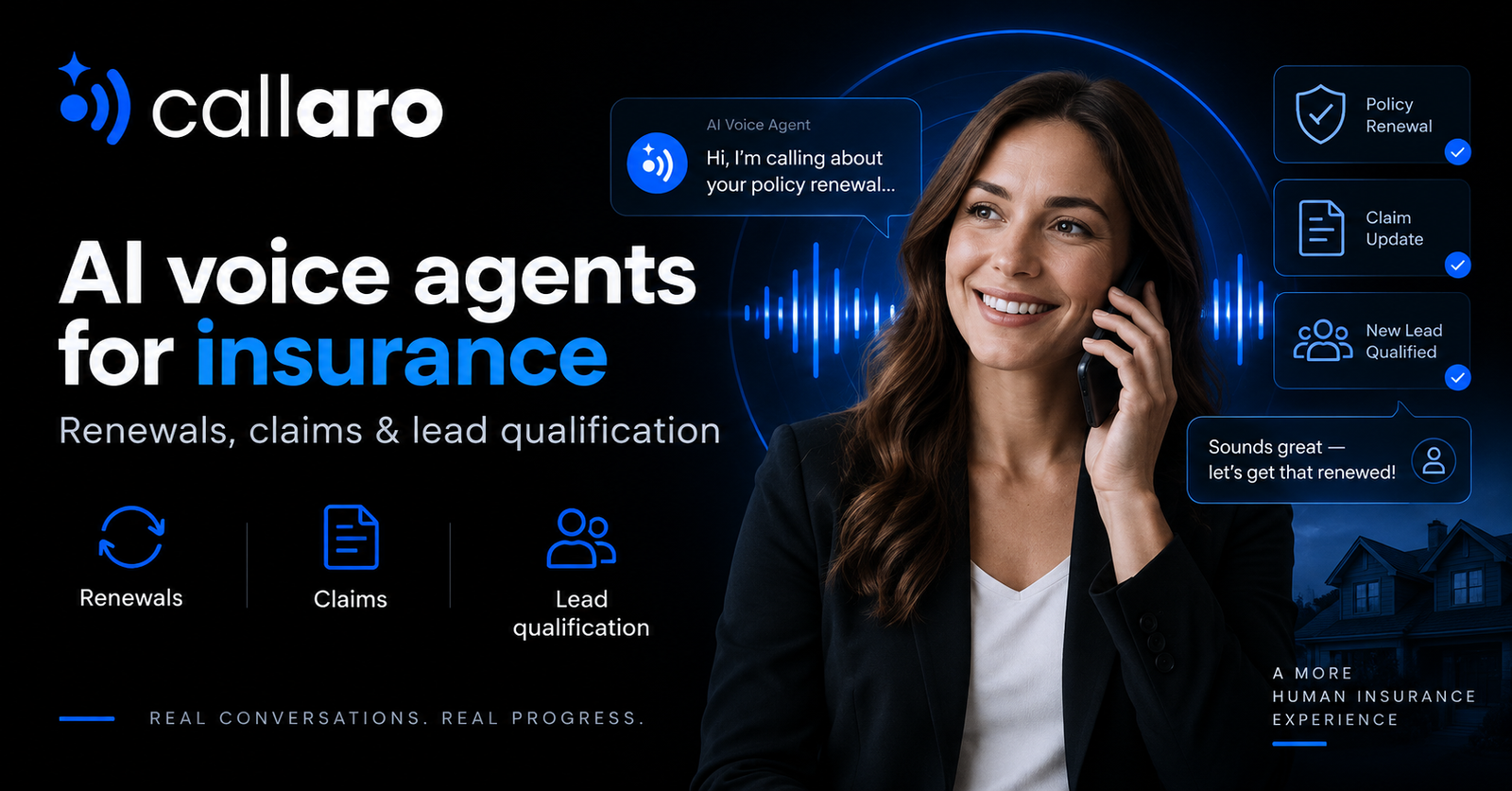
An AI voice agent for insurance is a conversational phone agent that automatically runs the repetitive, high-volume calls that drive your retention and loss ratio — renewal reminders and premium collection, new-lead qualification, claim intimation and status updates, KYC and document follow-ups, and lapsed-policy reactivation. It works 24/7, in the customer's language, and costs a small fraction of a loaded human agent's per-minute cost, so you can chase every renewal and qualify every lead without scaling headcount.
This playbook walks through the insurance-specific use cases, a savings model you can run with your own numbers, the benchmarks that tell you it's working, how it integrates, and the compliance discipline the industry demands. New to the category? Start with the complete guide to AI voice agents, then return for the insurance detail.
The five use cases that move insurance economics
1. Policy-renewal reminders and premium collection
Lapsed renewals are lost revenue you already earned the right to. A voice agent calls ahead of the due date, confirms the renewal, answers the common objections (premium changes, coverage questions), and texts a secure payment link — then follows up on the ones that don't pay on the first pass. This is the closest thing to found money in the book, and it's structurally similar to collections; our AI voice agents for collections playbook covers the promise-to-pay mechanics in depth.
2. New-lead qualification
Speed-to-lead decides conversion in insurance. An agent calls a fresh web or aggregator lead within a minute, confirms interest and eligibility, captures the basics (product, coverage need, budget band), and books a licensed advisor only for the leads worth an advisor's time. Your human closers stop dialling dead numbers and start every conversation with a warm, qualified prospect. For outbound at volume, see AI cold calling and outbound campaigns.
3. Claim intimation and status
The first-notice-of-loss call and the endless "what's the status of my claim" follow-ups are high-volume and mostly procedural. A voice agent takes the intimation, captures the structured details, opens the claim in your system, and — on inbound — reads back the live status and next step. It escalates anything complex or sensitive to a human immediately, with full context.
4. KYC and document follow-ups
Stalled applications and claims usually stall on a missing document. An agent chases the outstanding KYC item, explains exactly what's needed and how to submit it, texts the upload link, and keeps calling until the file is complete — recovering applications that would otherwise silently die in the pipeline.
5. Lapsed-policy reactivation
Win-back is cheaper than acquisition. A targeted, opt-out-respecting call to recently lapsed policyholders — with the specific reason to come back and a clear path to reinstate — reactivates a meaningful share of a book that broadcast email and SMS never touch.
The savings model: run your own numbers
Don't accept a headline percentage — build the model and plug in your own figures.
Human cost per call = average handle time (minutes) × loaded agent cost per minute (wages plus benefits, management, tooling, facilities — well above base wage).
AI cost per call = average handle time (minutes) × per-minute AI rate — the sum of STT, LLM, TTS and telephony, which you can check on your vendor's pricing page, depending on model, telephony and language.
Take a renewal-reminder call averaging 3 minutes — plug in your fully loaded human cost per minute and your AI vendor's rate to compare:
- Human: 3 min × your loaded human rate per minute = your human cost per call
- AI: 3 min × your vendor's AI rate per minute = your AI cost per call
That's roughly a 4–5x cost-per-call difference — before you count the revenue side, which in insurance is the bigger prize. Every renewal saved and every stalled application recovered is premium retained or written. So the honest way to size it is: (cost saved on volume you already handle) + (revenue from renewals, reactivations and qualified leads you weren't reaching because you ran out of human hours). Frame both as ranges, show the arithmetic, and the case is usually decisive. Firm up the per-minute number with how much AI voice agents cost and our pricing.
Book a demo and we'll build this model against your real renewal book and lead volume.
The benchmarks that tell you it's working
Set targets before launch. The ranges below are illustrative telephony starting points, not guarantees — your book, timezone spread and language mix will move them.
- Connect rate (outbound) — share of dials reaching a live person. Renewal and reactivation lists respond well to timezone-aware calling and sensible retry schedules; a low connect rate is almost always list quality, not the agent.
- Promise-to-pay / renewal-confirmation rate — the share of connected renewal calls that end in a committed payment or confirmed renewal. This is your core outbound KPI; track it per cohort and by days-to-due.
- Speed-to-lead — minutes from lead creation to first call. In insurance, calling within a minute versus an hour is a large swing in conversion.
- Containment / deflection rate (inbound) — share of claim-status and policy-question calls fully resolved without a human. Well-scoped flows contain most routine enquiries and hand off the rest cleanly.
- Latency / time-to-first-audio — sub-second, natural turn-taking keeps callers engaged and reduces drop-offs.
- QA / CSAT and complaint rate — your guardrail that automation isn't degrading experience or creating compliance exposure.
How it works: integrations and orchestration
The agent is only useful if it can reach your systems:
- Trigger — a renewal due-date, a new lead, an inbound claim call, or a KYC-pending flag fires the agent.
- Context — it pulls the policy, customer, claim or application record from your policy-admin system or CRM via API.
- Conversation — it talks naturally, understands intent, and takes real actions mid-call: confirming a renewal, texting a payment or upload link, opening a claim, or booking an advisor.
- Handoff & logging — anything sensitive or out of scope routes to a licensed human with full context, and every call is transcribed and written back to your CRM.
Doing those mid-call actions reliably, and picking the right model for latency and language, is the orchestration layer — see how our agents take real actions mid-call.
Compliance and quality notes
Insurance is among the most regulated industries for outbound calling, and the rules vary by market — so treat this as region-neutral discipline rather than legal advice. Respect calling-hours windows and do-not-call registries. Honour opt-outs immediately and permanently. Disclose that the caller is an AI where your jurisdiction requires it. Keep licensed-advice boundaries clear: a voice agent can qualify, inform and schedule, but binding advice, underwriting decisions and anything requiring a licensed representative must route to a human. Keep verbatim control over regulated disclosures rather than letting a model paraphrase them. Record and retain transcripts for audit and dispute resolution, and never collect full payment-card or bank-account numbers by voice — route payments to a secure link. Consult your compliance team on the specific rules in each market you operate in.
Why voice, when you already have email and SMS
Insurance communication is full of ignored reminders. A renewal email sits unread; an SMS gets swiped away. A voice call reaches the policyholder who tuned out the text, resolves a two-way question (a premium change, a coverage doubt, a claim status) in a single exchange, and carries the urgency that a deadline-driven business needs. It also serves the customers who genuinely prefer to call — often older or higher-value policyholders — without leaving them in a queue. The best programs sequence the channels: an SMS or email first, a voice call on the non-responders, and a final text with the payment or upload link. Voice catches the premium the other channels leak.
Multilingual reach and peak load
Insurance books are rarely monolingual, and a policyholder is far more likely to renew or complete KYC in a conversation held in their own language. A voice agent serves every language without a multilingual desk, and it absorbs seasonal spikes — renewal season, a catastrophe driving a wave of claim intimations — by scaling to concurrent calls instantly, then scaling back down. There's no overtime, no scramble to hire and train for a two-week surge. For how the agent handles accents and language switching mid-call, see multilingual voice AI, accents and code-switching.
Where to start
Don't automate everything at once. Pick the single use case with the clearest line to revenue — usually renewals or new-lead qualification — and run a bounded pilot: one flow, a defined cohort, tight scope, and immediate escalation to a licensed human for anything requiring advice. Measure the benchmarks above against pre-set targets. Once the model is proven, expand to the adjacent flows (premium collection after renewals; claim-status after lead qualification). Staging the rollout de-risks it and produces a defensible savings and retention figure at each step rather than a single large bet.
The bottom line
An AI voice agent for insurance protects premium and lowers cost-to-serve at the same time: it saves roughly 4–5x per handled call on renewals, claims-status and KYC follow-ups, while recovering renewals, reactivating lapsed policies and qualifying leads you couldn't reach with human hours alone. Start with renewals and lead qualification — the two use cases with the clearest revenue line — prove the model, then expand into claims and win-back.
See the full picture on our insurance solutions page, and when you want to see it run against your own book, book a demo.
Written by Callaro Team
Field notes from the team building Callaro's voice AI platform.
Frequently asked questions
What is an AI voice agent for insurance?+
It's a conversational phone agent that automatically runs an insurer's high-volume calls — renewal reminders and premium collection, lead qualification, claim intimation and status, KYC and document follow-ups, and lapsed-policy reactivation — 24/7 and in the customer's language, integrated with your policy-admin system or CRM so it can confirm renewals, open claims, and text payment or upload links mid-call.
How much can an insurer save with a voice AI agent?+
Build the model: human cost per call is handle time times loaded agent cost per minute; AI cost is handle time times your vendor's per-minute rate, which combines STT, LLM, TTS and telephony and lands well below a loaded human minute. For a 3-minute renewal call that is often several times cheaper per call — and in insurance the larger prize is the revenue side: renewals retained, applications recovered and leads qualified that you couldn't reach with human hours alone.
Can a voice agent handle insurance claims?+
It handles the procedural parts well — taking first-notice-of-loss intimation, capturing structured claim details, opening the claim in your system, and reading back live status on inbound calls. Anything complex, sensitive or requiring judgement is escalated immediately to a human with full context. The agent removes the routine volume, not the adjuster.
Is AI calling compliant in insurance?+
It can be, but insurance is heavily regulated and the rules vary by market. Respect calling-hours windows and do-not-call registries, honour opt-outs permanently, disclose the AI where required, keep licensed-advice boundaries clear so binding advice routes to a human, keep verbatim control of regulated disclosures, never collect full card or account numbers by voice, and retain transcripts for audit. Confirm the specific rules with your compliance team per market.
How does a voice agent qualify insurance leads?+
It calls a fresh lead within a minute, confirms interest and basic eligibility, captures the product, coverage need and budget band, and books a licensed advisor only for leads worth an advisor's time. Speed-to-lead is decisive — calling within a minute rather than an hour materially lifts conversion — and your closers start every conversation with a warm, qualified prospect.
What metrics should I track for insurance voice AI?+
Connect rate on outbound, promise-to-pay or renewal-confirmation rate, speed-to-lead in minutes, containment/deflection rate on inbound claim-status calls, latency or time-to-first-audio, and a CSAT/complaint guardrail. Set illustrative target ranges before launch and measure per cohort so you're managing against a plan rather than a hope.
Related articles

Gemini Live retirement: what changes for voice agents on 17 November
Google retires the Gemini API's preview Live and TTS models on 17 November 2026. Swapping in Gemini 3.8 Live is a one-line change; its new defaults for tool calls, silence and TTS prompts are not. Here is what changes, which date applies on which surface, and how to re-test each agent.

Voice AI for BPOs and contact centers: sell outcomes, not seats
For a BPO, voice AI is a commercial decision before it's a technology one. Put the AI tier where clients get nothing today (overflow, after-hours, callbacks, quality review), price it on resolved outcomes, and work out your containment floor before you quote: a transferred call costs more than a human-only one, so break-even sits higher than most teams assume.

Omnichannel AI agents explained: test the seams, not the channel list
An omnichannel AI agent is one agent with one memory per customer, serving calls, WhatsApp, chat, SMS, RCS and email, and able to act across them mid-conversation. Every vendor now claims that, so the label tells you little. What separates platforms is the six seams where a journey crosses channels: identity, memory, action, events, people and consent. Here's what breaks at each, and how to test it.
See the platform run a real call.
Book a demo and we'll show you outcomes executed end-to-end.
Book a demo