

AI voice agents for financial services (BFSI): use cases, ROI & benchmarks
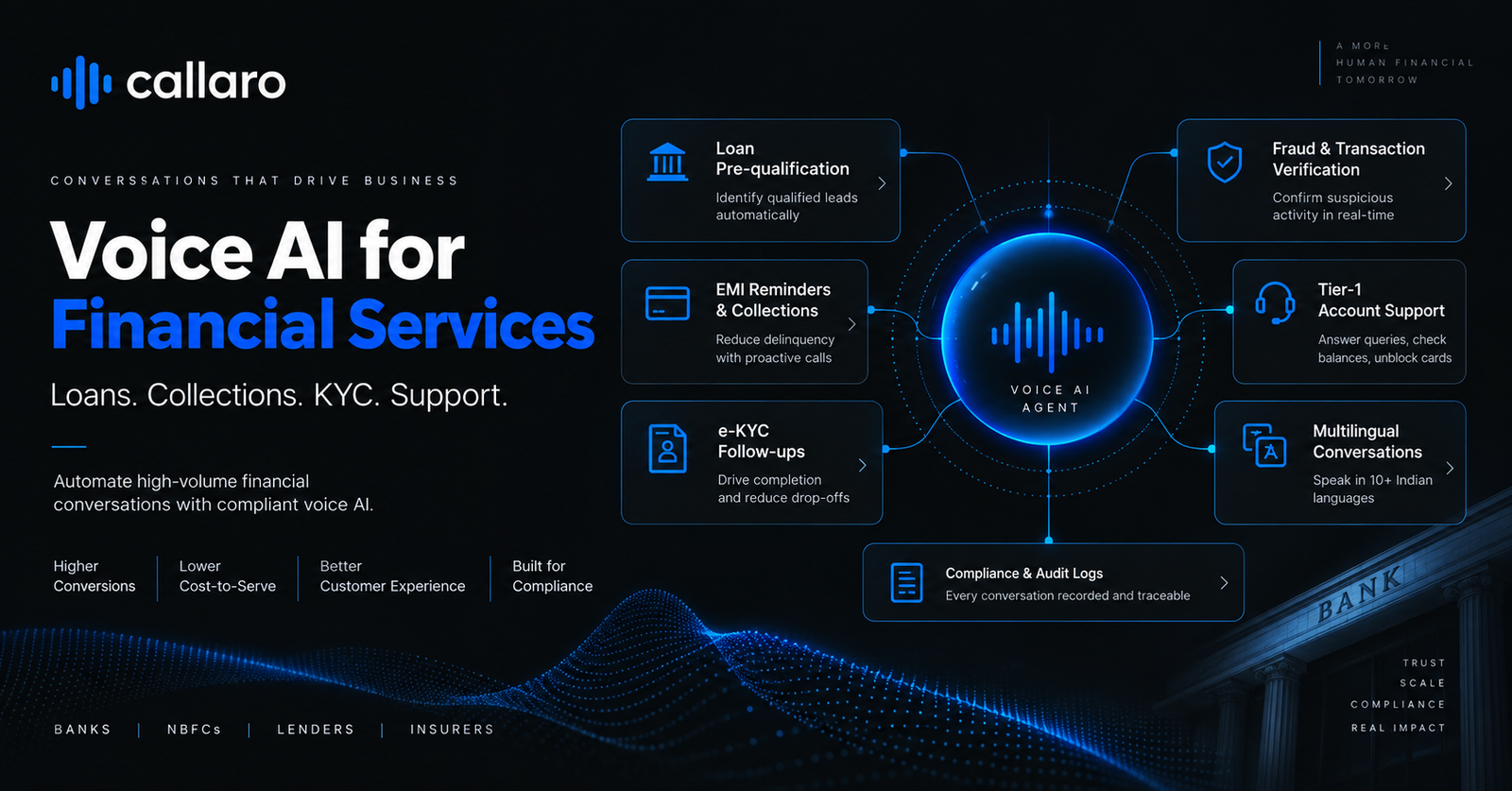
An AI voice agent for financial services makes and answers phone calls at scale — pre-qualifying loans, chasing EMI and payment reminders, following up on e-KYC, verifying transactions and handling tier-1 account queries — so BFSI teams reach more customers, collect faster and cut cost-to-serve, typically at a fraction of the cost of a live agent minute.
AI voice agents for financial services (BFSI): use cases, ROI & benchmarks
An AI voice agent for financial services is software that places and answers real phone calls on your behalf — qualifying loan applicants, reminding borrowers about upcoming EMIs, nudging e-KYC completions, verifying suspicious transactions and resolving routine account questions — in a natural, back-and-forth conversation. For banks, NBFCs, lenders and insurers, the outcome is simple: you reach far more customers per day, collect earlier in the cycle, and lower cost-to-serve, because an AI minute typically costs a fraction of a loaded human-agent minute and the agent works 24/7 without ramp time.
This guide covers where voice AI actually earns its place in BFSI, a transparent ROI model you can plug your own numbers into, the benchmarks that tell you whether a deployment is working, how it integrates with your stack, and the compliance guardrails that matter when you are calling people about money. For the foundational concepts, start with our complete guide to AI voice agents, then explore what a BFSI-specific rollout looks like on our financial services solutions page.
Top use cases for voice AI in BFSI
Financial services is one of the highest-value homes for voice AI because so much of the work is high-volume, script-driven phone contact that still has to feel personal and stay compliant.
- Loan and credit pre-qualification. Inbound and web leads get an instant call that captures intent, income band, loan purpose and documents needed, then books a callback with a human loan officer for anyone who qualifies. Speed matters here: the first lender to reach an applicant usually wins the application.
- EMI and payment reminders / early collections. Polite, consistent reminder calls before and just after the due date recover far more than letters or SMS alone, and they scale to your entire early-bucket book without adding headcount. See our collections voice AI guide and the detailed EMI collections playbook.
- e-KYC and onboarding follow-ups. Half-finished applications are lost revenue. An agent calls to walk customers through the pending step, answer document questions and re-share links, lifting completion rates on stalled onboarding.
- Fraud and transaction verification. For flagged or unusual transactions, an outbound call confirms whether the customer authorised the activity and escalates to a human or fraud queue when the answer is anything other than a clean yes.
- Tier-1 account support. Balance queries, statement requests, card-block confirmations, branch timings and 'where is my payment' calls are handled instantly, freeing your contact centre for the complex, high-empathy conversations that genuinely need a person.
A savings / ROI model you can actually check
Don't take a vendor's headline percentage on faith. Model it yourself. The arithmetic is straightforward, and the point is to show the method so you can drop in your real inputs.
Inputs:
- Call volume per month (V) — say 40,000 reminder and follow-up calls.
- Average handle time (AHT) — say 3 minutes per connected call.
- Loaded human-agent cost — salary, benefits, supervision, seat, telephony — this is your fully loaded human-agent-minute rate, and it typically runs several times higher than a metered AI-agent minute. Pull your own number from payroll and overhead rather than a generic figure.
- AI cost per minute is the sum of four metered components — STT, the LLM, TTS, and telephony — and lands well below a loaded human-agent minute. The exact number depends on which models and telephony you pick, so check current rates on your vendor's pricing page rather than assuming a fixed figure.
The math: 40,000 calls x 3 minutes = 120,000 minutes/month.
- At your loaded human rate, multiply it by these 120,000 minutes to see your monthly phone-labor bill for this volume.
- Run the same 120,000 minutes at your AI vendor's current per-minute rate and compare: in illustrative runs with realistic assumptions, teams typically see this line item fall by roughly a third to a half — and the AI handles the volume without overtime, attrition or ramp.
So for this illustrative mix you would typically see per-minute cost fall meaningfully, and the bigger win is usually capacity: the same team now supervises exceptions instead of dialing. Plug your own AHT, volume and loaded cost into the same formula — `(V x AHT x rate)` for each side — and compare. Blended human-plus-AI models (AI for tier-1 and reminders, humans for complex and escalated calls) usually give the best economics. For plan-level per-minute numbers, see pricing, and for how a voice AI program is costed end to end, our guide to what AI voice agents cost.
Book a demo and we will build this model with your actual call volumes.
Benchmarks: what good looks like for BFSI voice AI
Metrics keep a deployment honest. Here is a practical framework with realistic, clearly illustrative target ranges for telephony — treat them as starting points to measure against, not guarantees.
- Connect / right-party contact rate. The share of dials that reach the intended person. For well-timed outbound on a clean list, connect rates commonly land in the range of 25–45%; disciplined retry windows and local caller ID push the upper end.
- Containment / self-serve rate. For tier-1 support, the share of calls fully resolved without a human. Mature deployments on suitable call types often reach 50–75% containment.
- Speed-to-lead. Time from a new loan or web lead arriving to the first call attempt. The target is well under a minute; automated dialing makes near-instant contact realistic.
- Promise-to-pay (PTP) rate. In early collections, the share of reached borrowers who commit to a payment. This varies by bucket and geography, but it is the metric that ties directly to recovery, so track PTP and kept-promise rate together.
- CSAT / sentiment. Post-call satisfaction and live sentiment signals catch a poor experience before it costs you a customer.
- Latency / time-to-first-audio. How quickly the agent responds after the customer stops speaking. Sub-second response feels natural; long gaps make people talk over the agent or hang up. Ask any vendor for their real telephony latency, not a lab demo number.
How it works and what it integrates with
A BFSI voice agent is only as useful as the systems it can read from and write back to. In practice the agent connects to your loan origination system, core banking or card platform, CRM and collections tools so it can greet the right customer, reference the correct outstanding amount or application stage, and log the outcome automatically.
Mid-call, the agent orchestrates actions — looking up a balance, sending a payment or KYC link over SMS or WhatsApp, capturing a promise-to-pay, or transferring to a live officer with full context — rather than just reading a script. Our orchestration engine is what turns a conversation into those real actions and clean handoffs. Callaro also supports Indian telephony alongside international carriers, which matters for BFSI teams running domestic loan and collections books, and it handles multilingual, code-switching conversations that are common across Indian and other multilingual markets — see multilingual voice AI.
A compliance and quality note
Calling people about money is regulated, and a voice AI program has to respect that from day one — the specifics vary by jurisdiction, so align with your compliance team.
- Calling hours. Restrict outbound to permitted local windows and per-customer time zones; never dial outside them.
- Do-not-call and consent. Honour DNC lists and suppression flags, respect opt-outs immediately, and only call numbers you have a lawful basis to contact.
- Disclosures and identification. Where required, the agent should identify the caller and the purpose of the call and provide any mandated disclosures — including, in many markets, that the customer is speaking to an automated assistant.
- Audit logs and recordings. Retain call recordings, transcripts and outcome logs so every interaction is reviewable for disputes, quality and regulatory audits. Complete audit trails are also what let you tune the program safely.
- Data handling. Keep sensitive financial data inside controlled systems, never in insecure fields, and mask or tokenise where appropriate.
Good platforms make these controls configurable rather than leaving them to the prompt, so compliance is enforced at the system level.
How to roll it out without disrupting your book
The teams that succeed with BFSI voice AI start narrow and expand on evidence. A sensible sequence:
- Pick one high-volume, low-risk workflow first — usually pre-due-date EMI reminders or tier-1 FAQ calls. These have clear success metrics and little downside if a call is imperfect.
- Run a controlled pilot against a slice of your book, with humans reviewing transcripts daily for the first week or two. This is where audit logs earn their keep — you tune the script, the retry windows and the escalation rules from real conversations, not assumptions.
- Measure against the benchmarks above and against a matched human-handled control group, so you are comparing like for like.
- Expand to adjacent workflows — early collections, e-KYC nudges, then verification — once the first is stable, reusing the same integrations and guardrails.
- Keep humans in the loop for exceptions. The goal is not to remove your agents but to let them handle the escalated, high-empathy and high-value conversations while the AI absorbs the repetitive volume.
This phased approach also makes the business case self-evident: each stage produces its own before-and-after numbers, so the rollout funds itself. If you are still comparing vendors at this point, our guide to choosing an AI voice agent covers the questions that matter most for regulated industries.
The bottom line
For BFSI, an AI voice agent is not a novelty — it is a way to contact more borrowers and applicants, collect earlier, complete more onboarding, and resolve routine calls instantly, while your specialists focus on the conversations that truly need a human. Build the ROI model with your own numbers, hold the deployment to the benchmarks above, and insist on system-level compliance controls.
Ready to see it on your book? Book a demo or explore the financial services solution in detail.
Written by Callaro Team
Field notes from the team building Callaro's voice AI platform.
Frequently asked questions
What can an AI voice agent do for a bank, NBFC or lender?+
It can place and answer phone calls to pre-qualify loan and credit leads, send EMI and payment reminders for early collections, follow up on incomplete e-KYC and onboarding, verify flagged transactions, and handle tier-1 account queries like balances and statements. It works around the clock and logs every outcome back to your systems.
How much can voice AI save a financial services team?+
It depends on your call volume, average handle time and loaded agent cost. An AI minute is the sum of four metered components — STT, LLM, TTS and telephony — and typically costs a fraction of a loaded human-agent minute, so per-minute cost usually falls meaningfully — but the larger gain is capacity, since the same team supervises exceptions instead of dialing. Model it as call volume times handle time times your current per-minute rate for each side.
Is it compliant to use AI voice agents for collections and reminders?+
It can be, when configured correctly. You must respect permitted calling hours and time zones, honour do-not-call and opt-out lists, provide any required disclosures (including that the caller is automated where mandated), retain recordings and audit logs, and handle financial data securely. Rules vary by jurisdiction, so align the setup with your compliance team.
Which BFSI metrics should I track to know if voice AI is working?+
Track connect / right-party contact rate, containment or self-serve rate for support calls, speed-to-lead for new applications, promise-to-pay and kept-promise rate for collections, CSAT or sentiment, and telephony latency (time-to-first-audio). Set illustrative target ranges and measure against them over time.
Does an AI voice agent integrate with our loan, core banking and CRM systems?+
Yes. A production voice agent connects to your loan origination system, core banking or card platform, CRM and collections tools so it can reference the correct customer, amount or application stage, take actions mid-call (send a payment or KYC link, capture a promise-to-pay), and transfer to a human with full context.
Can it handle Indian telephony and multiple languages?+
Yes. Callaro supports Indian telephony alongside international carriers and can hold multilingual, code-switching conversations, which is useful for domestic loan and collections books across multilingual markets.
Related articles

Gemini Live retirement: what changes for voice agents on 17 November
Google retires the Gemini API's preview Live and TTS models on 17 November 2026. Swapping in Gemini 3.8 Live is a one-line change; its new defaults for tool calls, silence and TTS prompts are not. Here is what changes, which date applies on which surface, and how to re-test each agent.

Voice AI for BPOs and contact centers: sell outcomes, not seats
For a BPO, voice AI is a commercial decision before it's a technology one. Put the AI tier where clients get nothing today (overflow, after-hours, callbacks, quality review), price it on resolved outcomes, and work out your containment floor before you quote: a transferred call costs more than a human-only one, so break-even sits higher than most teams assume.

Speech-to-speech vs pipeline voice AI: choose per call, not per platform
Speech-to-speech and pipeline voice agents are no longer separated by latency. After eight days in which every pipeline stage gained a faster model and speech-to-speech systems stopped blocking on reasoning, the choice comes down to which guarantees a call needs. Here is what each path can't do, from running both in production, and a rule for choosing per call type.
See the platform run a real call.
Book a demo and we'll show you outcomes executed end-to-end.
Book a demo