

GPT-Live-1: full-duplex voice AI, and why Callaro was live with it on day one
OpenAI launched GPT-Live-1 on September 10, 2026 — a full-duplex speech model that listens and speaks at the same time and delegates reasoning to a backend of your choosing. Callaro has run it in production since launch day. Here's what full-duplex changes, and why it makes for the most natural AI voice agent yet.
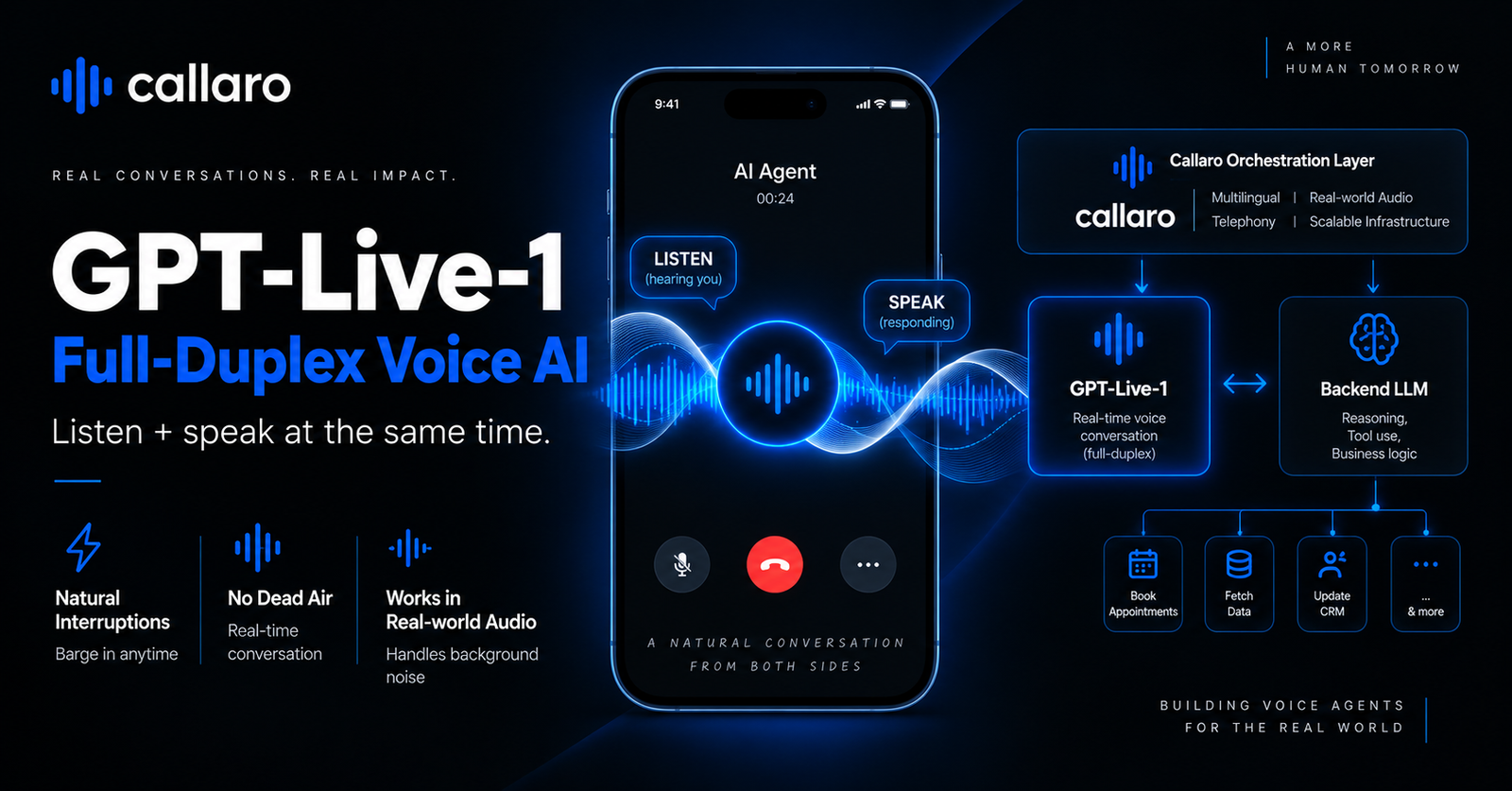
On September 10, 2026, OpenAI launched GPT-Live-1 — a full-duplex voice model that can listen and speak at the same time, handle interruptions and background noise inside a single model, and delegate reasoning and tool use to a backend model of your choosing. Callaro has run GPT-Live-1 in production since launch day. This post explains what "full-duplex" actually changes for a phone call, why the delegation design matters, and how we turned a raw speech model into a complete voice agent — including the parts that are genuinely hard.
If you're new to how these systems fit together, start with the complete guide to AI voice agents. If you want the architecture underneath this post, read building on a frozen speech-to-speech model.
What "full-duplex" means — and why it matters on a phone call
Most voice AI to date has been half-duplex: the agent listens, then speaks, then listens again, taking turns like a walkie-talkie. It works, but it feels a beat slow, and interruptions are awkward — you have to stop the agent, wait for it to notice, and start over.
Full-duplex means the model listens while it speaks. That single change fixes the things that make AI calls feel robotic:
- Natural interruptions (barge-in). You can cut in mid-sentence and the agent hears you immediately and yields — the way people actually talk. (Barge-in is deceptively hard; more in our voicemail detection teardown, which shares the same audio-loop challenges.)
- Real backchannel. The agent can register an "mm-hm" or a correction without a full stop-and-restart.
- Lower perceived latency. Because listening never pauses, the conversation has no dead air between turns.
- Noise and overlap handled in-model. GPT-Live-1 handles interruptions and background noise within the model itself, rather than bolting on separate turn-detection logic.
For telephony specifically — where people talk over each other, background noise is constant, and even a half-second of dead air feels broken — full-duplex is the difference between "clearly a bot" and "wait, was that a person?"
The design that makes it usable: conversation vs. backend
Here's the part that matters for building real products. GPT-Live-1 is not one model doing everything. It splits the job:
- GPT-Live-1 owns the conversation — listening, speaking, turn-taking, interruptions, and the voice (12 voice options).
- A backend model of your choice owns the reasoning — deciding what to do, calling tools, looking things up, applying your business logic.
This is exactly the delegation pattern we'd already built our realtime stack around, which is why we were able to ship GPT-Live-1 the day it launched instead of re-architecting for it. The live model is the mouth and ears; a swappable delegate is the brain. Tool definitions and business logic live with the delegate, so they don't consume the live model's tight instruction budget, and you can pick the reasoning model independently of the voice. We go deep on this in the frozen speech-to-speech model post.
Why this makes for the best AI voice agent — with the right platform around it
A raw speech model, however good, is not a voice agent. GPT-Live-1 gives you a spectacular mouth and ears; everything that makes it do a job sits around it. What we layer on:
- In-call orchestration. Real actions mid-conversation — CRM writebacks, bookings, payment links, lookups — via tools, HTTP APIs and MCP servers, with a prior tool's output feeding the next. See orchestration.
- Any backend model. Because reasoning is delegated, you choose the brain — and you're insulated when models change or sunset (see model migrations and sunsets).
- Multilingual reach. Native-sounding languages and code-switching, which interact subtly with a speech model's own language coverage — see multilingual voice AI.
- Real-world audio. Noise, echo and background-media handling tuned for actual phone lines, including noisy markets and Indian PSTN — see noisy calls.
- Telephony + scale. Bring-your-own-carrier, bulk campaigns, and the pacing to run them.
Full-duplex is the leap in how it sounds; the platform is what makes it earn its keep.
The honest hard parts (that we'd already solved)
Shipping a speech-to-speech model in production surfaces problems demos never show. Because we'd been building on this pattern, we hit them early:
- Don't freeze the audio loop while the backend thinks. If you await the delegate inline, audio, transcripts and barge-in all stall. Delegation has to run as a background task.
- Every delegated token gets spoken — and billed as voice time. A long backend answer becomes minutes of speech. Answers must be kept tight.
- Send only the new turn to the delegate, not the whole transcript each time, or cost and latency balloon.
- Verbatim isn't guaranteed. A speech model voices text in its own way; for legally exact disclosures we fall back to a classic text-to-speech path.
- Sessions expire and have concurrency tiers. Long calls need reconnect handling, and bulk outbound has to respect per-tier session ceilings.
We wrote these up in detail in building on a frozen speech-to-speech model. The point isn't that GPT-Live-1 is hard — it's that a production platform has to have already answered these questions before it's safe to point at your customers.
Where this is going
GPT-Live-1 is a clear signal of the direction: the speech layer and the reasoning layer are separating, so the voice gets more human while the brain stays swappable and controllable. OpenAI is also moving its older realtime model line forward (GPT-Realtime is slated to retire in early 2027 in favor of a newer version), which is exactly why building on a stable delegation architecture — rather than hard-coding one model — is the durable choice. Our whole approach to model migrations is designed for this.
If you want to hear a full-duplex agent that also books, looks up, and follows through, see it on a real call. And if you're comparing platforms, our how to choose a voice AI agent checklist covers exactly what to test.
Written by Callaro Engineering
Field notes from the team building Callaro's voice AI platform.
Frequently asked questions
What is GPT-Live-1?+
GPT-Live-1 is OpenAI's full-duplex voice model, launched September 10, 2026. It listens and speaks at the same time, handles interruptions and background noise within the model, and delegates reasoning and tool use to a backend model of your choosing.
What does full-duplex mean for a voice agent?+
Full-duplex means the model listens while it speaks, instead of taking strict turns. That enables natural interruptions (barge-in), backchannel, and no dead air between turns — which is what makes a call feel human rather than robotic, especially over noisy phone lines.
How is GPT-Live different from GPT-Realtime?+
GPT-Realtime used a single model for speech, reasoning and tool selection. GPT-Live splits the conversation (the speech model) from the backend (a reasoning model you choose). This delegation design keeps the natural voice while letting you pick and swap the brain, and keeps tool definitions off the speech model's instruction budget.
Is a raw speech model enough to run real calls?+
No. GPT-Live-1 provides natural conversation, but a production voice agent also needs in-call orchestration (tools, APIs, CRM writebacks), multilingual handling, real-world noise/echo handling, telephony, scale, and safeguards for verbatim messages, session expiry and concurrency. The platform around the model is what makes it useful.
Has Callaro implemented GPT-Live-1?+
Yes — Callaro has run GPT-Live-1 in production since its launch on September 10, 2026. Because Callaro's realtime stack was already built around the delegation pattern (a live speech model plus a swappable reasoning backend), adopting GPT-Live-1 on day one required no re-architecture.
Related articles

Gemini Live retirement: what changes for voice agents on 17 November
Google retires the Gemini API's preview Live and TTS models on 17 November 2026. Swapping in Gemini 3.8 Live is a one-line change; its new defaults for tool calls, silence and TTS prompts are not. Here is what changes, which date applies on which surface, and how to re-test each agent.

Voice AI for BPOs and contact centers: sell outcomes, not seats
For a BPO, voice AI is a commercial decision before it's a technology one. Put the AI tier where clients get nothing today (overflow, after-hours, callbacks, quality review), price it on resolved outcomes, and work out your containment floor before you quote: a transferred call costs more than a human-only one, so break-even sits higher than most teams assume.

Speech-to-speech vs pipeline voice AI: choose per call, not per platform
Speech-to-speech and pipeline voice agents are no longer separated by latency. After eight days in which every pipeline stage gained a faster model and speech-to-speech systems stopped blocking on reasoning, the choice comes down to which guarantees a call needs. Here is what each path can't do, from running both in production, and a rule for choosing per call type.
See the platform run a real call.
Book a demo and we'll show you outcomes executed end-to-end.
Book a demo