

AI voice agents for healthcare & clinics: scheduling, reminders & ROI
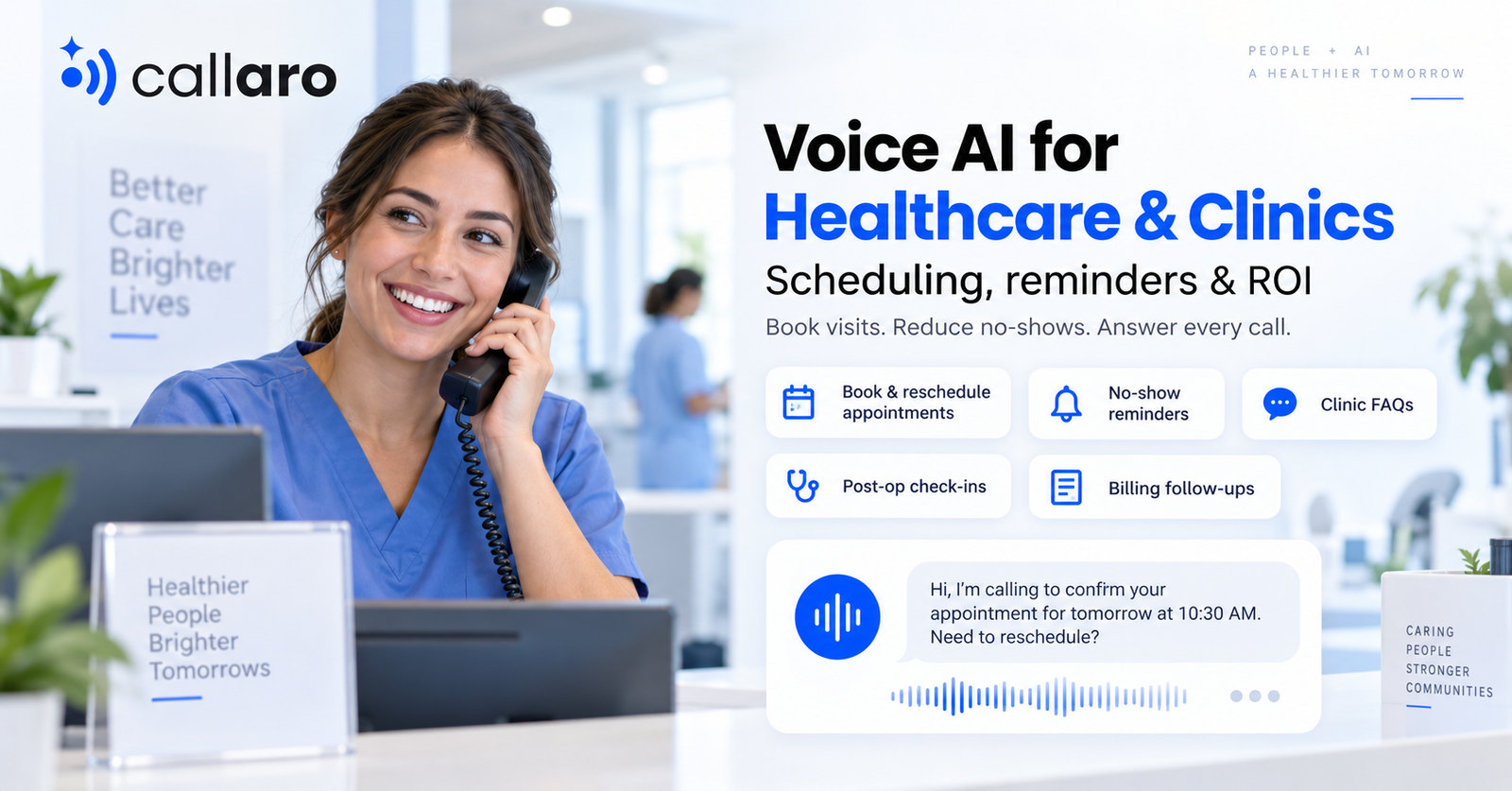
An AI voice agent for healthcare and clinics answers and makes patient calls at scale — booking and rescheduling appointments, running no-show reminders, doing post-op and wellness check-ins, answering clinic FAQs and chasing billing — so front desks stop drowning in phone traffic, fewer slots go empty, and staff focus on patients in the room.
AI voice agents for healthcare & clinics: scheduling, reminders & ROI
An AI voice agent for healthcare and clinics is software that answers and places patient phone calls in a natural conversation — booking and rescheduling appointments, sending no-show reminders, running post-op and wellness check-ins, answering routine clinic FAQs and following up on billing. For a clinic or hospital front office, the outcome is immediate: the phone stops ringing off the hook, fewer appointment slots sit empty, and reception staff spend their time on the patient standing at the desk instead of the queue on hold.
This guide walks through the highest-value use cases for clinics, a transparent ROI model, the benchmarks that show whether it is working, how it fits your practice management stack, and the privacy and emergency-handoff safeguards that are non-negotiable in a clinical setting. For the fundamentals, see our complete guide to AI voice agents, and for a healthcare-specific rollout, our healthcare solutions page.
Top use cases for voice AI in clinics and healthcare
Healthcare front-office work is a near-perfect fit for voice AI: enormous phone volume, repetitive but important tasks, and long hold times that frustrate patients and staff alike.
- Appointment booking and rescheduling. Patients call any time — including nights and weekends — and the agent offers open slots, books, reschedules or cancels, and writes it straight to your calendar. No hold music, no voicemail tag.
- No-show reminders. Empty chairs are lost revenue and lost care. Timed reminder calls (with an easy confirm-or-reschedule option) reliably cut no-shows, and freed slots can be offered to a waitlist automatically.
- Post-op and wellness check-ins. After a procedure or for chronic-care follow-up, the agent calls to confirm the patient is following instructions, ask a short set of scripted questions, and flag anyone whose answers warrant a clinician callback — a safe, high-touch use as long as it routes concerns to a human.
- Clinic FAQs. Opening hours, location and parking, what to bring, insurance and documentation questions, prescription-refill process — answered instantly, in the patient's language, without tying up the front desk.
- Billing follow-ups. Gentle reminders on outstanding balances, help understanding a statement, and re-sharing payment links, handled consistently across your whole patient base.
Because so much of this is about answering fast and never leaving a patient on hold, it pairs naturally with the ideas in our guide to cutting hold times with 24/7 AI phone support.
A savings / ROI model you can check yourself
Rather than trust a headline number, model the economics with your own figures. The method is what matters.
Inputs:
- Call volume per month (V) — say 12,000 inbound and reminder calls across a multi-location practice.
- Average handle time (AHT) — say 3.5 minutes per connected call.
- Loaded front-desk cost — wages, benefits, supervision, phone system — this is your fully loaded front-desk-minute rate, and it typically runs several times higher than a metered AI-agent minute. Pull your own number from payroll and overhead rather than a generic figure.
- AI cost per minute is the sum of four metered components — STT, the LLM, TTS, and telephony — and lands well below a loaded front-desk minute. The exact number depends on which models and telephony you pick, so check current rates on your vendor's pricing page rather than assuming a fixed figure.
The math: 12,000 calls x 3.5 minutes = 42,000 minutes/month.
- At your loaded human rate, multiply it by these 42,000 minutes to see your monthly phone-handling labor cost.
- Run the same 42,000 minutes at your AI vendor's current per-minute rate and compare: in illustrative runs with realistic assumptions, teams typically see this line item fall by roughly a third to a half — and it absorbs after-hours and peak-time spikes without extra staff.
The direct per-minute saving is real, but for clinics the bigger returns are usually recovered revenue from fewer no-shows and reception time given back to in-person patients. A handful of filled slots a week that would otherwise have gone empty often outweighs the call-handling cost entirely. Plug your own volume, AHT and loaded cost into `(V x AHT x rate)` for each side, then add your average slot value times the no-shows you expect to recover. See pricing for per-minute plan detail and our guide to AI voice agent costs for the full picture.
Book a demo and we will build this model around your appointment volumes and slot values.
Benchmarks: what good looks like for healthcare voice AI
Use a metric framework to keep the deployment honest. These target ranges are illustrative starting points for telephony, not promises.
- Containment / self-serve rate. Share of calls fully handled without a human — booking, rescheduling, FAQs. On suitable call types, mature deployments often reach 50–75%.
- No-show reduction. Measure your no-show rate before and after reminder calls go live; well-run reminder programs typically move it by a meaningful margin, and the freed slots are the headline ROI.
- Connect rate for outbound reminders. The share of reminder dials that reach the patient; well-timed calls commonly land in the range of 30–50%, with SMS or WhatsApp fallback catching the rest.
- Speed-to-answer. Inbound calls should be answered in the first ring or two — no queue. This is where voice AI structurally beats a busy front desk.
- CSAT / sentiment. Post-call satisfaction and live sentiment flags catch a frustrated patient early.
- Latency / time-to-first-audio. Sub-second response after the patient stops speaking feels natural; long gaps feel robotic. Ask for real telephony latency numbers, not a scripted demo.
How it works and what it integrates with
A clinic voice agent has to plug into the systems your front desk already uses. In practice it connects to your practice management system, scheduling calendar, EHR/EMR where permitted, and billing or CRM tools, so it can see real availability, recognise a returning patient, book against the right provider, and log every interaction automatically.
Mid-call it orchestrates actions — offering genuinely open slots, sending a confirmation or intake form over SMS or WhatsApp, re-sharing a payment link, or warm-transferring to a nurse or the front desk with context — rather than reciting a static script. Our orchestration engine is what turns the conversation into those real actions and clean handoffs. Callaro also supports Indian telephony alongside international carriers and handles multilingual, code-switching conversations, which helps clinics serving patients across languages.
A privacy and emergency-handoff note
Healthcare calls carry sensitive information and, occasionally, real urgency. Two safeguards are essential — and the specifics depend on your jurisdiction and clinical governance, so involve your compliance and clinical leads.
- Emergency handoff. The agent is for scheduling and routine follow-up, not triage. It must recognise urgent or distress signals and immediately direct the patient to emergency services or a human clinician, with a clear, well-tested escape path. Never let an automated agent attempt to manage a medical emergency.
- Privacy and data handling. Treat patient data as protected health information: identify the patient appropriately before sharing details, keep sensitive data inside controlled systems, mask or tokenise where appropriate, and never place health information in insecure fields or URLs. Align retention of recordings and transcripts with your regulatory obligations.
- Consent and disclosure. Where required, disclose that the patient is speaking with an automated assistant and that the call may be recorded, and honour opt-outs immediately.
- Scope discipline. Keep the agent to non-clinical tasks (logistics, reminders, FAQs, billing) and route anything approaching medical advice to a qualified professional.
Strong platforms enforce these at the system level rather than relying on the prompt to behave.
How to roll it out in a clinic setting
The practices that get the most from voice AI start with one workflow and grow on evidence, keeping clinical governance close.
- Begin with no-show reminders or after-hours booking — high-volume, low-risk, and the ROI (recovered slots, calls answered outside working hours) shows up within weeks.
- Pilot on one location or one department first, with front-desk staff reviewing transcripts and confirming bookings landed correctly. Tune the slot logic, the reminder timing and the escalation rules from real calls.
- Test the emergency-handoff path explicitly before going live, so you know exactly how the agent behaves when a patient signals distress or urgency.
- Measure against the benchmarks above and against your pre-AI no-show and answer-rate baselines.
- Expand to check-ins, FAQs and billing once booking is stable, reusing the same calendar and PMS integration.
- Keep clinical staff in the loop — the agent handles logistics and routine follow-up, and anything approaching medical judgment always routes to a qualified person.
Because each stage produces its own before-and-after numbers — slots filled, calls answered, hold time removed — the rollout makes its own case as it grows. If you are weighing vendors, our guide to choosing an AI voice agent covers what to probe for.
The bottom line
For clinics and healthcare providers, an AI voice agent answers every call instantly, keeps the schedule full, runs reminders and check-ins reliably, and hands off urgent or clinical matters to the right person — all while giving reception staff their day back. Model the ROI on your own slot values and volumes, hold it to the benchmarks above, and insist on emergency handoff and privacy controls built into the system.
Want to see it on your schedule? Book a demo or explore the healthcare solution in detail.
Written by Callaro Team
Field notes from the team building Callaro's voice AI platform.
Frequently asked questions
What can an AI voice agent do for a clinic or hospital?+
It answers and places patient calls to book, reschedule and cancel appointments, send no-show reminders, run post-op and wellness check-ins, answer routine FAQs like hours and directions, and follow up on billing. It works 24/7, writes bookings to your calendar, and hands off urgent or clinical matters to staff.
How much can voice AI save a healthcare practice?+
It depends on your call volume, handle time and loaded front-desk cost. An AI minute is the sum of four metered components — STT, LLM, TTS and telephony — and typically costs a fraction of a loaded reception minute, so per-minute cost usually drops — but for clinics the bigger returns are recovered revenue from fewer no-shows and reception time given back to in-person patients. Model it as call volume times handle time times your current vendor rate, plus recovered slot value.
How does an AI voice agent handle a medical emergency?+
It should not attempt to. A properly configured healthcare agent handles scheduling and routine follow-up only. It must recognise urgent or distress signals and immediately direct the patient to emergency services or a human clinician through a clear, well-tested escape path, never trying to triage or manage an emergency itself.
Is a healthcare voice agent private and compliant with patient data rules?+
It can be when configured correctly: treat patient data as protected health information, identify the patient before sharing details, keep sensitive data in controlled systems, mask where appropriate, disclose automation and recording where required, honour opt-outs, and align recording retention with regulations. Requirements vary by jurisdiction, so involve your compliance and clinical leads.
Which metrics show whether a healthcare voice agent is working?+
Track containment / self-serve rate, no-show rate before and after reminders, connect rate on outbound reminders, speed-to-answer on inbound calls, CSAT or sentiment, and telephony latency (time-to-first-audio). The recovered appointment slots from fewer no-shows are usually the clearest ROI signal.
Can it book directly into our scheduling system?+
Yes. A production voice agent connects to your practice management system, scheduling calendar, EHR/EMR where permitted, and billing tools, so it sees real availability, books against the right provider, sends confirmations or intake forms, and logs every interaction automatically.
Related articles

Gemini Live retirement: what changes for voice agents on 17 November
Google retires the Gemini API's preview Live and TTS models on 17 November 2026. Swapping in Gemini 3.8 Live is a one-line change; its new defaults for tool calls, silence and TTS prompts are not. Here is what changes, which date applies on which surface, and how to re-test each agent.

Voice AI for BPOs and contact centers: sell outcomes, not seats
For a BPO, voice AI is a commercial decision before it's a technology one. Put the AI tier where clients get nothing today (overflow, after-hours, callbacks, quality review), price it on resolved outcomes, and work out your containment floor before you quote: a transferred call costs more than a human-only one, so break-even sits higher than most teams assume.

Omnichannel AI agents explained: test the seams, not the channel list
An omnichannel AI agent is one agent with one memory per customer, serving calls, WhatsApp, chat, SMS, RCS and email, and able to act across them mid-conversation. Every vendor now claims that, so the label tells you little. What separates platforms is the six seams where a journey crosses channels: identity, memory, action, events, people and consent. Here's what breaks at each, and how to test it.
See the platform run a real call.
Book a demo and we'll show you outcomes executed end-to-end.
Book a demo