

AI voice agents for e-commerce & retail: recover carts, deflect support
An AI voice agent for ecommerce recovers abandoned carts, answers "where is my order" calls, verifies COD orders and handles returns — automatically, 24/7, at a fraction of a loaded human cost per minute. Here are the highest-ROI use cases, a savings model you can plug your own numbers into, and the benchmarks that tell you it's working.
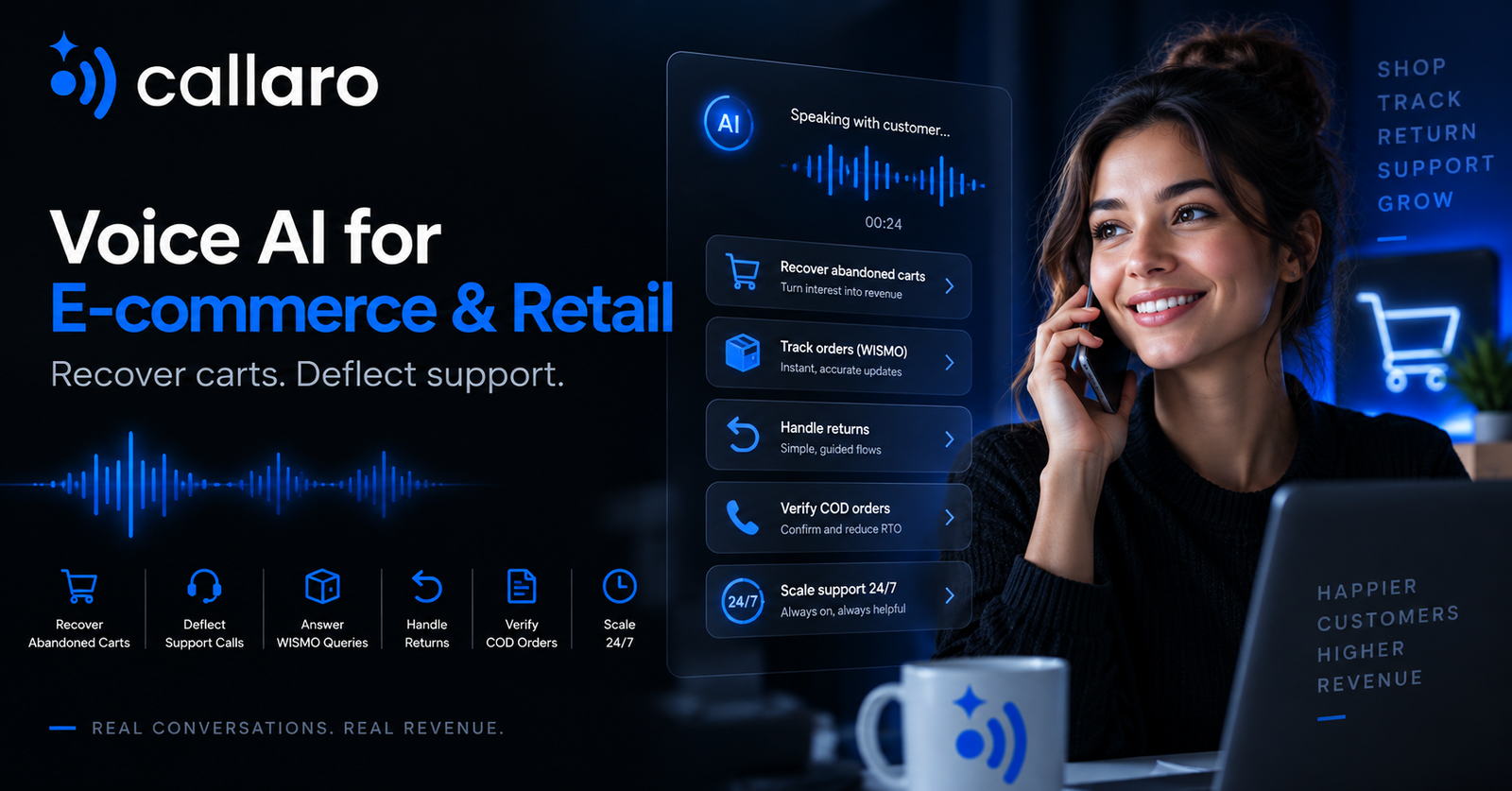
An AI voice agent for ecommerce is a conversational phone agent that places and answers calls for your store automatically — recovering abandoned carts, handling "where is my order" enquiries, verifying cash-on-delivery orders, and processing returns — 24/7 and in the customer's language. The economics are the headline: instead of a loaded human cost of several dollars per handled call, a voice agent runs at a small fraction of that per minute — check your vendor's pricing page for the current rate — so the same team can cover far more volume without adding headcount at peak.
This playbook covers where voice AI earns its keep in retail, a savings model you can run with your own numbers, the benchmarks that tell you it's working, and how it plugs into your store and helpdesk. If you're new to the category, start with our complete guide to AI voice agents for the fundamentals, then come back here for the retail specifics.
The five highest-ROI use cases in retail
Not every call is worth automating. These five are, because they're high-volume, repetitive, and directly tied to revenue or cost-to-serve.
1. Abandoned-cart recovery calls
Most stores recover carts with email and SMS, which get ignored. A short, well-timed voice call — placed minutes after abandonment while intent is still warm — cuts through in a way a fourth email never will. The agent references the exact items left behind, answers the objection that stalled the checkout (shipping cost, a sizing question, a payment worry), and can text a one-tap resume link mid-call. This is the single most revenue-positive outbound play in retail; we go deep on it in recovering abandoned carts with voice AI.
2. WISMO / order-tracking ("where is my order?")
Order-status calls are the largest single bucket of retail support volume and almost none of it needs a human. A voice agent looks up the order against your commerce platform or OMS, reads back the live status and expected delivery window, and offers to text the tracking link. Deflecting this category alone typically frees a large share of agent time for the calls that actually need judgement.
3. Returns and RMA
Returns are procedural: verify the order, confirm eligibility against your policy window, capture the reason, and issue an RMA or pickup slot. A voice agent runs that script consistently every time, logs the reason code for your merchandising team, and escalates only the genuine exceptions.
4. COD and order verification
In cash-on-delivery markets, unverified orders drive costly failed deliveries and return-to-origin losses. An outbound agent confirms the order, the address, and intent to pay on delivery within minutes of checkout — cancelling or flagging the ones that don't confirm before you ever dispatch. This is pure margin protection.
5. VIP re-engagement and upsell
For high-value or lapsed customers, a personalised call — new arrivals in a category they buy, a loyalty perk, a restock of something they viewed — lands better than a broadcast. Used sparingly and with clear opt-out, it lifts repeat-purchase rate on your best customers.
The savings model: run your own numbers
Don't take a vendor's "X% saved" on faith — build the model. The arithmetic is simple:
Human cost per call = average handle time (minutes) × loaded agent cost per minute. "Loaded" means wages plus benefits, management, tooling, facilities and shrinkage — usually well above the base wage.
AI cost per call = average handle time (minutes) × per-minute AI rate — the sum of your STT, LLM, TTS and telephony costs, which you can check on your vendor's pricing page, depending on model, telephony and language.
Work a realistic WISMO example. Say a support call averages 4 minutes — plug in your fully loaded human cost per minute and your vendor's AI per-minute rate to see the comparison:
- Human: 4 min × your loaded human rate per minute = your human cost per call
- AI: 4 min × your vendor's AI rate per minute = your AI cost per call
That is roughly a 4–5x cost-per-call difference on a category that can be 30–50% of your inbound volume. Multiply by your monthly WISMO count and you have a defensible savings range — typically substantial, but the point is you plugged in your handle time, your loaded cost and your volume rather than trusting a headline number. Layer in the revenue side (recovered carts, prevented COD RTO losses) and the case usually pays for itself well before you reach full deployment. See how much AI voice agents cost and our pricing to firm up the per-minute figure for your setup.
Book a demo and we'll build this model live against your real call mix and handle times.
The benchmarks that tell you it's working
Savings mean nothing if the experience degrades. Track these, and set targets before you launch so you're measuring against a plan, not a hope. Treat the ranges below as illustrative starting points for telephony, not guarantees — your traffic, language mix and hours will move them.
- Connect rate (outbound) — share of dials that reach a live person. For cart-recovery and COD verification, aim for a healthy connect rate by calling in the customer's timezone and retrying on a sensible schedule; poor list hygiene, not the agent, is the usual culprit when it's low.
- Containment / deflection rate (inbound) — share of calls fully resolved without a human. For well-scoped WISMO and returns flows this can be high; the honest target is "most of the routine stuff, cleanly handed off on the rest."
- Speed-to-lead (cart recovery) — minutes from abandonment to first call. Faster is dramatically better; the difference between a call in 5 minutes and one in an hour is large.
- Latency / time-to-first-audio — how quickly the agent starts responding. Sub-second, natural turn-taking is what keeps callers from talking over the agent or hanging up.
- CSAT / callback rate — did customers rate the interaction well, and did fewer of them call back for the same issue? This is your quality guardrail.
Our field notes on cutting hold times with 24/7 AI phone support walk through how these numbers move once inbound is automated.
How it works: integrations and orchestration
A retail voice agent is only as good as the systems it can reach. The pattern is:
- Trigger — a cart-abandonment webhook, a new COD order, or an inbound call hits the agent.
- Context — the agent pulls the order, customer and inventory state from your commerce platform (Shopify, WooCommerce, Magento) or OMS via API.
- Conversation — it talks naturally, understands the intent, and takes real actions mid-call: reading order status, issuing an RMA, texting a resume or tracking link, or scheduling a re-delivery.
- Handoff & logging — anything out of scope routes to a human with full context, and every call is transcribed and logged back to your helpdesk or CRM.
The hard part is doing those mid-call actions reliably and picking the right model for latency and language — that's the orchestration layer. See how our agents take real actions mid-call for the mechanics.
Compliance and quality notes
Retail outbound is regulated in most markets. Respect calling-hours windows and do-not-call lists, honour opt-outs immediately, and disclose that the caller is an AI where your jurisdiction requires it. Keep verbatim control over any legally sensitive message (offers, disclosures) rather than letting a model paraphrase. Record and retain transcripts for QA and dispute resolution, and mask payment data — a voice agent should never ask a customer to read out a full card number over the phone; route payment to a secure link instead.
Why voice, when you already have email and SMS
Email and SMS are cheap, so the fair question is why add a phone channel at all. The answer is intent and speed. A voice call reaches people who ignore a fourth marketing email, it resolves a two-way problem (a sizing doubt, a wrong address, a payment worry) in one exchange instead of a slow back-and-forth, and it carries a human sense of urgency that text does not. It also handles the customers who prefer to call — older demographics, high-value orders, anyone anxious about money — without making them wait in a queue. Voice doesn't replace your other channels; it catches the revenue and the resolutions they leak. Used well, the sequence is often SMS first, then a voice call on the ones that don't respond, then a final SMS with the resume or tracking link — each channel doing what it's best at.
Peak season and multilingual scale
Retail volume is spiky: a sale, a holiday, a viral product, and your call volume triples overnight. This is exactly where a voice agent earns its place, because it scales to concurrent calls instantly with no hiring, training or overtime — and scales back down when the peak passes. It also serves every customer in their own language without staffing a multilingual desk, which matters if you sell across regions. The agent that greets a customer in their language, references their exact order, and resolves it in one call is a materially better experience than a long hold followed by a language mismatch. For the mechanics of accents and language switching mid-call, see multilingual voice AI, accents and code-switching.
Where to start
Don't boil the ocean. Pick the one use case that dominates your call mix — for most stores that's WISMO on the inbound side or cart recovery on the outbound side — and run a bounded pilot: one flow, real orders, tight scope, clear escalation to humans. Measure the benchmarks above against the targets you set. Once the model is proven on that flow, expand to the adjacent ones (returns after WISMO; COD verification after cart recovery). This staged approach de-risks the rollout and gives you a defensible savings figure at each step rather than a big-bang bet.
The bottom line
An AI voice agent for ecommerce moves two numbers at once: it lifts recovered revenue (carts, verified COD orders, re-engaged VIPs) and it lowers cost-to-serve (WISMO, returns) by roughly 4–5x per handled call versus loaded human cost. Start with the two use cases that dominate your call mix — usually cart recovery and WISMO — prove the model on those, then expand.
See the full retail picture on our e-commerce solutions page, and when you're ready to see it on your own catalogue and call data, book a demo.
Written by Callaro Team
Field notes from the team building Callaro's voice AI platform.
Frequently asked questions
What is an AI voice agent for ecommerce?+
It's a conversational phone agent that automatically places and answers calls for an online store — recovering abandoned carts, answering order-status enquiries, verifying cash-on-delivery orders, and handling returns — 24/7 and in the customer's language, integrated with your commerce platform so it can take real actions like reading order status or issuing a return.
How much can a retailer save with a voice AI agent?+
Build the model rather than trusting a headline: human cost per call is handle time times loaded agent cost per minute; AI cost is handle time times your vendor's per-minute rate, which is the sum of STT, LLM, TTS and telephony and sits well below a loaded human minute. For a typical 4-minute WISMO call that is often several times cheaper per call, on top of recovered revenue from carts and prevented COD losses. Plug in your own volume, handle time and current vendor rate for a defensible figure.
Can a voice agent recover abandoned carts better than email?+
Often yes, because a well-timed call placed within minutes of abandonment cuts through when a fourth email is ignored. The agent references the specific items, answers the objection that stalled checkout, and can text a one-tap resume link mid-call. Speed-to-lead matters most: a call in five minutes materially outperforms one an hour later.
Which retail calls should stay with humans?+
Automate the high-volume, repetitive, script-driven calls — order tracking, returns, COD verification, cart recovery. Keep humans for genuine exceptions, complaints requiring judgement or empathy, and edge cases outside policy. A good agent contains the routine volume cleanly and hands off everything else with full context.
How does a voice agent connect to Shopify or my OMS?+
Through APIs. On a trigger — a cart-abandonment webhook, a new order, or an inbound call — the agent pulls order, customer and inventory data from your commerce platform or order-management system, acts on it during the call, and writes the transcript and outcome back to your helpdesk or CRM.
Is outbound retail calling with AI compliant?+
It can be, if you respect calling-hours rules and do-not-call lists, honour opt-outs immediately, disclose the AI where required, keep verbatim control of any legally sensitive message, and never collect full card numbers by voice. Record transcripts for QA and route payments to a secure link instead of the call.
Related articles

Gemini Live retirement: what changes for voice agents on 17 November
Google retires the Gemini API's preview Live and TTS models on 17 November 2026. Swapping in Gemini 3.8 Live is a one-line change; its new defaults for tool calls, silence and TTS prompts are not. Here is what changes, which date applies on which surface, and how to re-test each agent.

Voice AI for BPOs and contact centers: sell outcomes, not seats
For a BPO, voice AI is a commercial decision before it's a technology one. Put the AI tier where clients get nothing today (overflow, after-hours, callbacks, quality review), price it on resolved outcomes, and work out your containment floor before you quote: a transferred call costs more than a human-only one, so break-even sits higher than most teams assume.

Omnichannel AI agents explained: test the seams, not the channel list
An omnichannel AI agent is one agent with one memory per customer, serving calls, WhatsApp, chat, SMS, RCS and email, and able to act across them mid-conversation. Every vendor now claims that, so the label tells you little. What separates platforms is the six seams where a journey crosses channels: identity, memory, action, events, people and consent. Here's what breaks at each, and how to test it.
See the platform run a real call.
Book a demo and we'll show you outcomes executed end-to-end.
Book a demo